
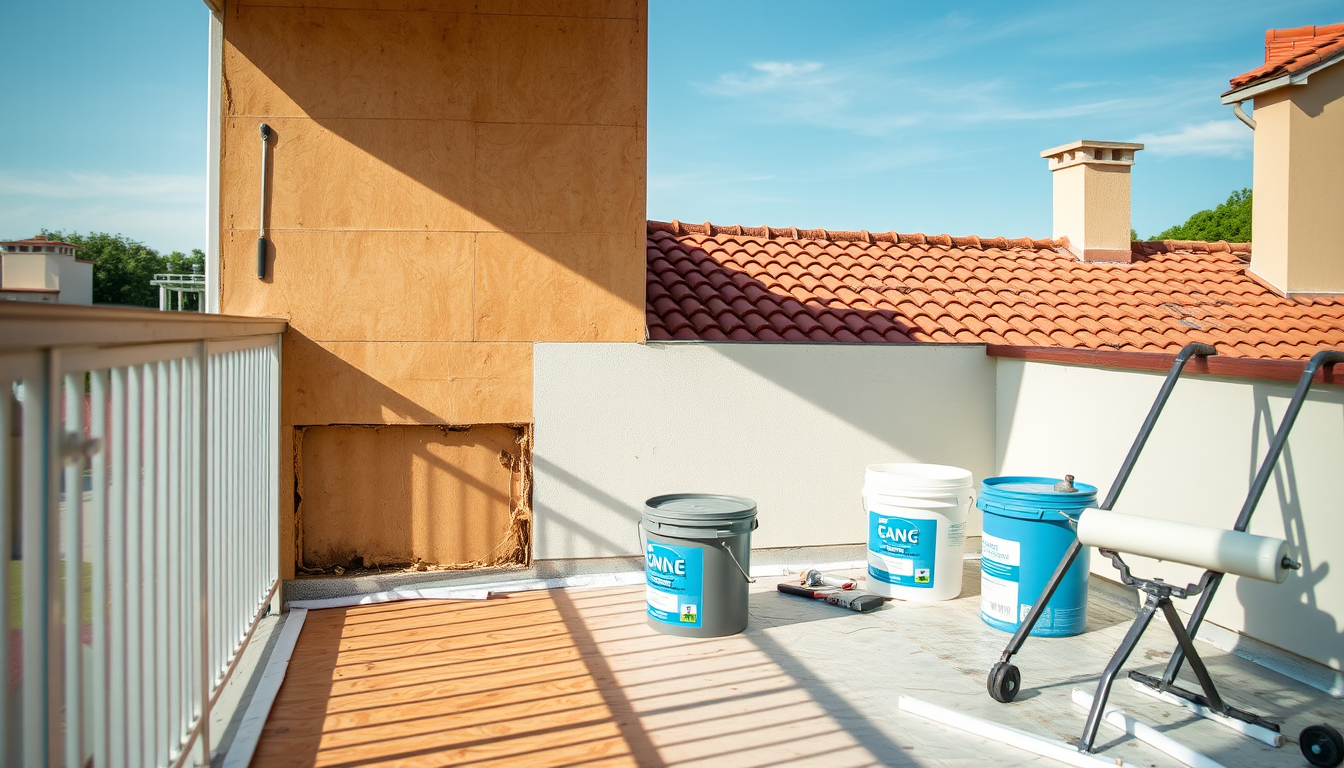
Balcony waterproofing cost in Los Angeles and Orange County is driven far less by the coating than by what the crew finds when the old coating comes off. Published Southern California contractor ranges start around $36 to $42 per square foot for a new waterproofing system on a sound deck. They run to $120 to $200 per square foot where there is major structural damage, per Bay Cities Construction’s published cost breakdown. That is a five-fold spread on the same balcony, and the waterproofing itself is usually the cheapest line item inside it.
So why does one bid come in at a third of another? Because most of the number is repair, not coating, and repair scope isn’t visible from the doorway.
Key takeaways
- Ranking pages hand you one per-square-foot band. Real balcony waterproofing cost moves on substrate condition, and nobody knows that condition until tear-off.
- Published Southern California tiers step up as scope goes deeper. Roughly $36 to $42 per square foot for system only, $50 to $60 with flashing replacement, $75 to $80 with subfloor replacement, $120 to $200 for major structural damage (Bay Cities Construction).
- Slope isn’t optional. The Desert Crete walking deck system is recognized for installation “on slopes not less than one-unit vertical in 48-units horizontal (2-percent slope)” (IAPMO UES Evaluation Report 586). Rebuilding slope is a framing cost, not a coating cost.
- A compliance repair on a covered multi-unit building prices differently than a homeowner recoat. It has to satisfy a permit and enforcement path on a fixed clock.
- The cheapest bid on the table almost always assumes no tear-off. That assumption is the whole difference.
Every dollar figure below is attributed to a named outside source with a link. Capital Deck & Stair does not publish prices, because an honest number requires standing on your deck. We’re a family-owned, California-licensed contractor (CSLB #1005325) that has been opening up balconies, decks and exterior stairs across Los Angeles and Orange County for more than 40 years. Here’s how the number actually gets built.
What Drives Balcony Waterproofing Cost, and Why Do Quotes Vary So Much?
The cost to waterproof a balcony in Los Angeles or Orange County is quoted as a per-square-foot rate, but that rate is a bundle. Balcony waterproofing cost bundles demolition, disposal, framing repair, sheathing, flashing, slope correction, the waterproofing system, the topcoat, permits and access into that one rate. Published Southern California figures show the bundle stepping up in four tiers as scope deepens. About $36 to $42 per square foot buys a new waterproofing system alone. Flashing replacement takes it to $50 to $60. Subfloor replacement takes it to $75 to $80. Major structural damage forces a rebuild at $120 to $200 (Bay Cities Construction).
| Published tier | What the scope covers | Per square foot |
|---|---|---|
| New system only | Waterproofing system on a balcony in good condition, with no significant flashing or stucco damage | $36 to $42 |
| Flashing replacement | Stucco removed, new flashing installed, then the waterproofing system applied over the existing deck | $50 to $60 |
| Subfloor replacement | Plywood subfloor replaced with new flashing and system, after water got past the membrane and started rot or fungal growth | $75 to $80 |
| Major structural damage | Same rebuild in the worst case, where the damage requires repair designs from a licensed engineer | $120 to $200 |
Those four tiers are published by Bay Cities Construction, a third-party Southern California contractor. They are not Capital Deck & Stair pricing. Note what the fourth tier adds: an engineer. Once the damage is structural, you’re paying for design work before anyone mixes a coating.
Look at what separates those tiers. It isn’t the membrane. Every tier installs waterproofing. What changes is how much of the assembly underneath has to be rebuilt first. A supplier guide covering California walking decks puts inspection-driven balcony repair at $36 to $200 per square foot, or roughly $1,500 to more than $30,000 per unit. It treats that spread as a scope ladder, not a price list (US Made Supply, Walking Deck Cost by Project Type). Soft costs ride on top: permit fees at $200 to $1,000 or more, engineering reports at $500 to $2,000 (Bay Cities Construction). Easy to leave off a bid to make it look competitive. They don’t disappear.
The 6 Cost Drivers, in the Order an Estimator Finds Them
Balcony waterproofing cost is set by six things: what tear-off exposes, dry rot in the framing and sheathing, whether the deck has enough slope to drain, penetrations at railing posts and door thresholds, site access and staging, and whether the job is one balcony or a whole property on a compliance schedule. They surface in that order, and only the first one is visible before demolition starts. That order matters, because it’s what makes a number move after the contract is signed.
1. Tear-off, and what’s under the coating
A balcony’s real condition isn’t knowable from the walking surface. A cracked topcoat and a flawless topcoat can sit over identical rot. Tear-off is the diagnostic step, and it’s why two honest contractors quote the same deck differently. One priced what they could see. The other priced what they expect to find.
On older LA apartment buildings we open a lot of magnesite, a cementitious topping poured over plywood that is common on mid-century multifamily stock. Once it delaminates from the sheathing it holds water against the plywood like a sponge. The deck can look fine from above for years while the substrate is finished.
2. Dry rot in the framing and sheathing
This is the single biggest swing in any balcony quote. Replacing joists, blocking, a ledger or sheets of plywood is carpentry, and carpentry is labor and time. The manufacturer’s specification assumes a sound platform before the system goes down. Desert Crete requires a wood subfloor of “minimum 5/8″ plywood.” That subfloor must be “of such design and of sufficient soundness, structural strength and rigidity, to withstand, without deflection or movement, the maximum surface conditions to which the finished floor will be subjected” (Hill Brothers Desert Crete Specifications, TB124). Soft plywood doesn’t meet that. It gets replaced, or the system goes down over a substrate the manufacturer never approved.
Southern California produces this damage in a specific pattern. Eight or nine months of hard UV chalks and micro-cracks the topcoat. Then the winter storms arrive in a handful of concentrated weeks and drive water into those cracks. The dry season runs long enough that nobody sees a ceiling stain below until the framing has been fed for two or three seasons. That lag is why so many LA and OC balconies go from “needs a recoat” to “needs framing” with no warning in between.
3. Slope, and whether the deck actually drains
A dead-flat balcony holds water, and standing water finds every seam eventually. Slope is a listing requirement, not a preference. IAPMO UES Evaluation Report 586 was revised January 6, 2026. It recognizes the Desert Crete walking deck system for installation “on slopes not less than one-unit vertical in 48-units horizontal (2-percent slope).” The manufacturer’s own specification recommends framing the subfloor “so as to provide 1/4″ per lineal foot fall in deck” (TB124).
If your balcony was framed flat, or if it settled, reaching that slope means sistering, shimming or re-sheathing. That work lands in the framing budget, not the coating budget. It’s one of the most common reasons a quote comes in above the neighbor’s.
4. Railing posts, door thresholds and flashing
Penetrations are where balconies leak and where scope hides. Every railing post through the deck is a hole in the waterproofing. Every door threshold is a horizontal joint between two assemblies that move differently. The Desert Crete specification calls for primed galvanized metal flashing at “all slider and door thresholds, jambs, posts, scuppers, walls, and fascia.” That is in accordance with building code requirements (TB124).
Doing those details right can mean pulling a railing, cutting back stucco, replacing corroded flashing and resetting a threshold. Skipping them means a deck that leaks in the same three places it always did. Flashing replacement alone moves the published band from $36 to $42 up to $50 to $60 per square foot (Bay Cities Construction). That is the cheapest insurance on the job.
5. Access and staging
A ground-floor patio and a third-floor walk-up balcony can carry identical square footage and very different labor. Everything on that third floor gets carried by hand: demo debris down, plywood and mixed material up. Desert Crete alone specifies galvanized metal lath at 2.5 pounds per square yard on top of the base coats, (TB124). The material going up that stairwell is not light. Add a tight side yard, a hillside lot, or a courtyard building where the only path runs through occupied units. Mobilization stops being trivial. On multi-unit work you’re also scheduling tenant notices and keeping an egress path open while a stairway is out of service.
6. One balcony, or forty units on a schedule
Volume cuts both ways. Forty balconies on one property share mobilization, staging and supervision, which helps the per-unit number. But a compliance-driven project carries per-unit documentation. It also carries phasing so residents keep access, and a repair sequence tied to a permit. That’s why the supplier guide cited above prices inspection-driven balcony repair per unit rather than per property. It puts that at roughly $1,500 to more than $30,000 per unit (US Made Supply). On a forty-unit building, the spread between those two ends is the entire reserve study. Which is why the inspection findings, not the square footage, set the budget.
Repair or Replace: Which One Are You Actually Buying?
The dividing line is structural, and it’s the largest single fork in any balcony waterproofing cost. If the framing and the ledger are sound and the failure is limited to the coating and the topping, it’s a repair. Deck coating and sealing over a properly prepared substrate may be the whole scope. If joists, the ledger or the deck’s connection back to the building are compromised, you’re buying a rebuild no matter what the invoice calls it. Published Southern California whole-project figures show that jump. A waterproofing recoat runs $3,000 to $8,000. A moderate repair and waterproofing project runs $8,500 to $15,000. Extensive repair runs $15,000 to $35,000. A full structural rebuild runs $40,000 to $50,000 or more (Bay Cities Construction).
Three questions settle it in the field. Does the deck feel soft or springy underfoot, especially near the building wall? Is there rust bleeding from railing bases or fasteners? Is there staining, efflorescence or a soft spot on the ceiling or soffit below? Any one of those points at the substrate, and substrate is where the money is. Our balcony repair and leak work starts by answering those three honestly, because getting them wrong sets the entire budget wrong.
Why Is the Cheapest Bid Usually a Skipped Tear-Off?
A bid that lands at a third of the others has usually deleted the same three line items: tear-off, a framing allowance, and flashing replacement. Those three are what separate the published Southern California tiers, where flashing replacement alone moves a deck from $36 to $42 up to $50 to $60 per square foot and subfloor replacement moves it to $75 to $80 (Bay Cities Construction).
Pricing a coating over the existing surface is a legitimate scope on a sound, correctly sloped deck. It is not a legitimate scope on a deck that’s already leaking.
The mechanism is simple. Waterproofing systems are specified to bond to a clean, sound, dry substrate. Coating over saturated plywood traps water on the wrong side of the membrane, where it keeps feeding the rot with no path to dry. The deck looks new for a season or two. The framing keeps going. Then the same building fails the same inspection, and the second repair prices from the tier above.
There’s a manufacturer-side check on this too. The Desert Crete specification states that the system “shall be installed only by a contractor trained and approved in writing by the manufacturer” (TB124). Ask every bidder which system they’re installing, whether the manufacturer has approved them to install it, and what happens to the balcony waterproofing cost if the plywood turns out to be soft. A contractor who has thought it through will give you the allowance up front. The systems we install and their manufacturer specifications are listed on our technical information page.
Do SB 721 and SB 326 Repairs Price Differently Than a Homeowner Recoat?
A repair driven by a balcony inspection report on a covered building carries a different cost profile than a homeowner recoat. It has to satisfy a code enforcement path on a fixed clock. As of today, July 30, 2026, both first-round California deadlines are already behind us. Health and Safety Code section 17973 is the SB 721 rental statute. It requires that the inspection “shall be completed by January 1, 2026, and by January 1 every six years thereafter” (California Health and Safety Code 17973). That date came from AB 2579, approved by the Governor on September 28, 2024, which moved the deadline out from January 1, 2025 (AB 2579 bill text). The condominium statute, Civil Code section 5551, set its first inspection deadline at January 1, 2025 and was not extended (California Civil Code 5551).
Three things in those statutes push directly on balcony waterproofing cost. First, scope is set by sampling, not by what looks worst. SB 721 requires “a sample of at least 15 percent of each type of exterior elevated element.” SB 326 instead requires enough units for 95 percent confidence, with a margin of error no greater than plus or minus 5 percent. Findings on the sample routinely expand the repair scope to matching units. Second, the schedule is fixed: 120 days from receipt of the report to apply for a permit, then 120 days to make the repairs absent an extension. Compressed schedules cost more than open-ended ones. Third, non-completion carries a civil penalty of “not less than one hundred dollars ($100) nor more than five hundred dollars ($500) per day until the repairs are completed.”
AB 2579 also preserved local authority. A city or county “may enact ordinances or laws imposing requirements greater than those imposed by this section,” so confirm your jurisdiction’s rules. None of this is legal advice. Verify your building’s status with your inspector, your local enforcement agency, or your attorney. We handle SB 721 and SB 326 compliance repairs from the inspector’s findings through permits to final sign-off, as the licensed contractor of record.
How a Real Balcony Waterproofing Cost Estimate Gets Built
A balcony waterproofing quote worth comparing lists demolition, the framing allowance, the waterproofing system, permits and engineering as separate lines. A single blended per-square-foot number hides which of those the contractor actually intends to do, and that’s exactly where two bids on one deck diverge. An estimate is written against a scope, not against a rate. When we walk a property, the quote gets assembled in this order:
- Measure the deck plus every stair run, landing and walkway tied to it.
- Sound the surface and probe at the wall line, the railing bases and the threshold for soft spots.
- Check fall across the deck against the 2-percent minimum slope the system listing requires.
- Price demolition and disposal separately from the waterproofing system.
- Write a stated allowance for framing and sheathing replacement, with a unit price. A discovery after tear-off then becomes a known number instead of an argument.
- List permits and any engineering separately rather than burying them.
Walkways and exterior stairs usually belong in the same scope. Folding them in at the same time is the one reliable way to hold total balcony waterproofing cost down. Mobilizing twice costs more than mobilizing once. The same crew, the same permit and the same staging cover a deck repair on the same elevation. Stairs are a load path with people on them, and stringers and landings rot from the inside where nobody looks. That’s why stair repair and waterproofing often runs on the same permit as the balcony work. Most projects are backed by an 8-year workmanship warranty.
Does any of that match what you’re looking at? A soft spot near the door, rust at a railing base, a stain on the ceiling below, or an inspection report with findings you now have to price. If so, call Capital Deck & Stair at 818-697-6334 for a free on-site estimate, or request a quote. Bring the report if you have one. We’d rather read it than guess at it.
About this article. Written and reviewed by the field team at Capital Deck & Stair Waterproofing. We are a family-owned California-licensed contractor (CSLB #1005325) at 7453 Woodley Ave, Van Nuys, CA 91406, serving Los Angeles County and Orange County for more than 40 years. Cost figures are attributed to the named third-party sources linked above and are not Capital Deck & Stair pricing. Every source linked in this article was read on July 30, 2026: the statutory language at leginfo.legislature.ca.gov, the published contractor cost tiers at baycitiesconstruction.com, the walking deck cost guide at usmadesupply.com, IAPMO UES Evaluation Report 586, and Hill Brothers technical bulletin TB124. Codes, listings and local ordinances change, so verify current requirements before acting on any of it. More about our crew and our history.
Frequently Asked Questions
Why is one balcony waterproofing quote three times another?
Almost always because the two bids assume different scopes under the coating. The low bid typically prices a system applied over the existing surface with no tear-off, no framing allowance and no flashing replacement. Published Southern California tiers show the same deck moving from roughly $36 to $42 per square foot for the waterproofing system alone. Add subfloor replacement and new flashing and it reaches $75 to $80 per square foot (Bay Cities Construction). Ask each bidder what happens to the price if the plywood is soft.
Does balcony size drive the cost more than damage does?
No. Size sets the baseline, condition sets the tier. Take a 60 square foot balcony with rotted joists and a failed ledger connection. It costs more than a sound 150 square foot balcony that is simply past the service life of its topcoat. That’s why published per-square-foot rates for inspection-driven repairs span roughly $36 to $200 per square foot (US Made Supply).
Can a balcony be waterproofed without removing the old coating?
Sometimes, but only when the existing surface is sound, dry and correctly sloped. Waterproofing systems are specified to bond to a sound substrate. The Desert Crete specification requires a subfloor of sufficient soundness, structural strength and rigidity to resist deflection or movement (TB124). Coating over saturated plywood seals moisture in against the framing, which is how a deck that looks new keeps rotting underneath.
How much slope does a balcony need to drain properly?
At least 2 percent for the systems we install. IAPMO UES Evaluation Report 586, revised January 6, 2026, recognizes the Desert Crete walking deck system for installation “on slopes not less than one-unit vertical in 48-units horizontal (2-percent slope).” The manufacturer’s specification recommends framing the subfloor to provide 1/4 inch per lineal foot of fall. Correcting slope on an existing flat deck is framing work and is priced as framing work.
Are SB 721 and SB 326 repairs more expensive than a normal balcony repair?
They carry a different balcony waterproofing cost profile rather than a fixed premium. The repair has to satisfy a permit and enforcement path, and sampling findings often expand the scope to matching units. The schedule is fixed too. Health and Safety Code 17973 allows 120 days to apply for a permit and 120 days to complete repairs, with a civil penalty of $100 to $500 per day for unfinished repairs (Health and Safety Code 17973). Confirm your obligations with your inspector or counsel, not with a contractor’s blog post.