
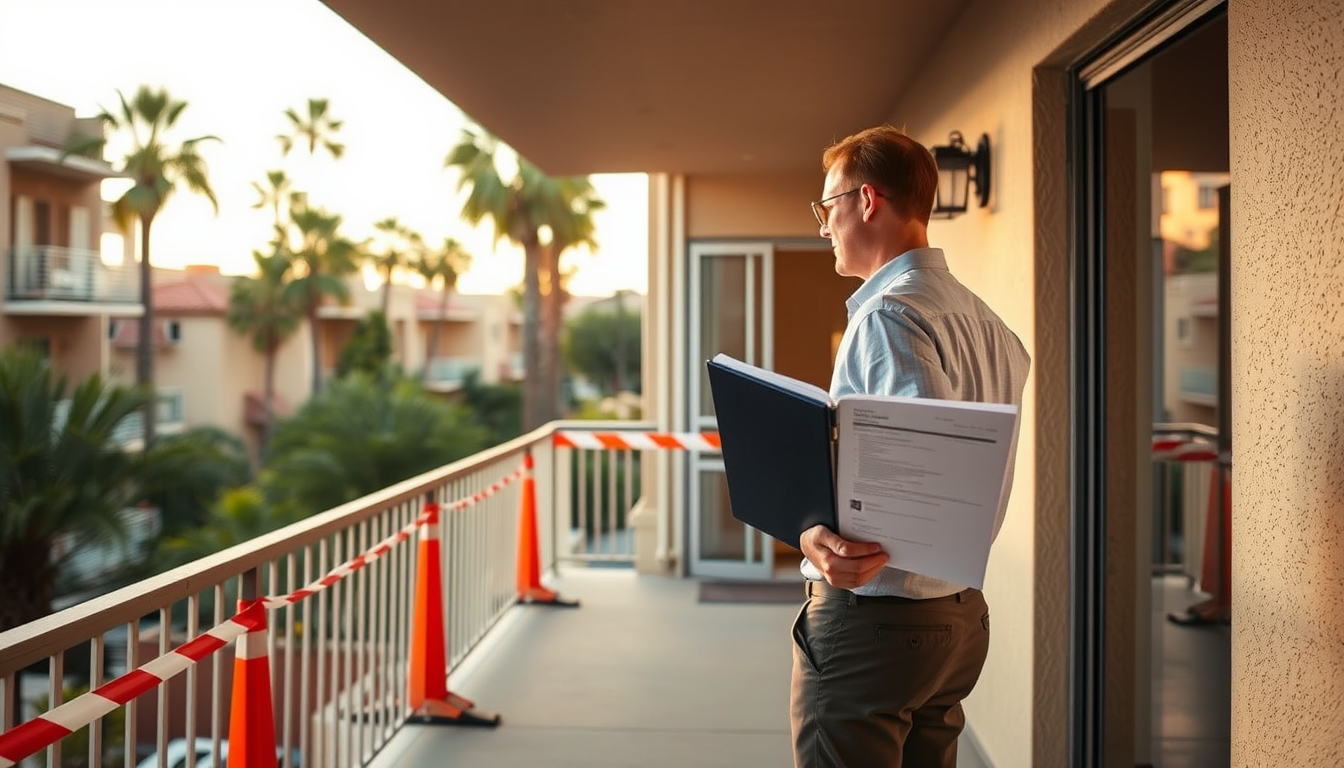
The SB 721 deadline for the first round of balcony and stairway inspections was January 1, 2026, and it has passed. If you own or manage an apartment building in Los Angeles or Orange County and nobody has looked at your exterior elevated elements, you’re late. You’re probably not being fined yet. Those are two different things, and the gap between them is worth real money. What follows is the penalty sequence written into California Health and Safety Code 17973, step by step.
Key Takeaways
- The initial inspection was due January 1, 2026 under Health and Safety Code 17973(d)(1), then every six years after that.
- The $100 to $500 per day civil penalty is tied to uncompleted repairs after a written notice, not to the missed inspection date itself.
- Four clocks run in sequence. 120 days to apply for a permit, 120 days to repair after permit approval, a 180-day non-compliance trigger, then 30 more days after the inspector’s notice.
- If a penalty is assessed, the local jurisdiction can record a building safety lien with the priority of a judgment lien and can recover its enforcement costs.
- SB 326, the condominium law, has a different deadline and no daily civil penalty at all.
This article reflects the law as published in August 2026 and describes what the statute says. It is not legal advice. Confirm your situation with your inspector, your city’s building department, or your attorney.
The SB 721 Deadline Passed January 1, 2026. Where Does That Leave You?
California Health and Safety Code 17973(d)(1) requires that the inspection “shall be completed by January 1, 2026, and by January 1 every six years thereafter.” That date is already behind us. The next statewide cycle lands on January 1, 2032. The original deadline was January 1, 2025. Assembly Bill 2579, Chapter 835, approved by the Governor on September 28, 2024, pushed it out by one year. There has been no second extension.
Which Buildings the SB 721 Deadline Covers
Who does the SB 721 deadline actually cover? Section 17973(a) applies to buildings with three or more multifamily dwelling units. Subdivision (b)(2) then defines an exterior elevated element. It’s a balcony, deck, porch, stairway, walkway or entry structure that extends past the exterior wall. Its walking surface sits more than six feet above ground level. And it relies “in whole or in substantial part on wood or wood-based products” for structural support. Subdivision (n) excludes common interest developments, which is why condos fall under a separate law.
A lot of older Los Angeles apartment stock lands squarely in that definition. Wood-framed walkways over a carport. Exterior stairs to a second-floor unit. A magnesite-topped balcony from the 1960s. Those are the assemblies we open on balcony repair jobs across Los Angeles most weeks of the year.
What the Inspection Has to Cover
The inspection is not a whole-building survey. It is not a look at the topcoat either. Subdivision (c)(2) requires “a sample of at least 15 percent of each type of exterior elevated element.” Type matters in that sentence. Balconies, walkways and stairways count separately, so a property with all three owes a sample from each.
What gets looked at is defined just as tightly. Subdivision (b)(3) calls the load-bearing components the parts that “deliver structural loads from the exterior elevated element to the building.” Subdivision (b)(1) then pulls in the “flashings, membranes, coatings, and sealants that protect the load-bearing components of exterior elevated elements from exposure to water.” Read those together and the waterproofing sits inside the scope of the inspection, not outside it.
When Does the SB 721 Penalty Clock Actually Start?
Under California Health and Safety Code 17973(i)(2), the SB 721 civil penalty of $100 to $500 per day starts only after three things happen. Repairs go uncompleted for 180 days. The inspector then notifies the local enforcement agency and the owner. Thirty further days pass with the work still unfinished. Missing the January 1, 2026 inspection date does not, by itself, start the meter.
That is the part most articles get wrong, and it’s the most useful thing a late owner can understand. The fine is tied to a chain of events. Every link in that chain has its own day count.
The Five Steps From Inspection to Civil Penalty
- Report delivered. The inspector presents a stamped or signed written report to the owner or the owner’s agent within 45 days of completing the inspection, per subdivision (c)(4).
- 120 days to pull a permit. For corrective work that does not pose an immediate threat, subdivision (h)(2) gives the owner 120 days from receipt of the inspection report to apply for a permit.
- 120 days to repair. “Once the permit is approved, the owner of the building shall have 120 days to make the repairs unless an extension of time is granted by the local enforcement agency,” per the same subdivision.
- 180 days triggers a notice. Under subdivision (i)(2), if the owner does not comply with the repair requirements within 180 days, the inspector notifies both the local enforcement agency and the owner.
- 30 more days, then the meter runs. If the repairs are still not done 30 days after the date of that notice, the owner “shall be assessed a civil penalty based on the fee schedule set by the local authority of not less than one hundred dollars ($100) nor more than five hundred dollars ($500) per day until the repairs are completed.” Again, that is unless the local agency grants an extension.
How the $100 to $500 Per Day Rate Gets Set
Read that last line carefully. The rate comes from the local authority’s fee schedule inside the statutory band. Los Angeles, Long Beach and Santa Ana can each land in a different place. The penalty accrues per day until you finish the repairs. Not per violation, not as a flat fine. At the top of the range, 365 days works out to $182,500, which is arithmetic on the statutory maximum rather than a published rate from any city.
What Happens If You Missed the SB 721 Deadline and Never Booked an Inspection
So what if you haven’t been inspected at all? No inspection means no report. No report means no repair clock, and nothing for the inspector to notify the enforcement agency about. Booking the inspection now does not start a fine. Sitting on a report that already lists corrective work is what starts the fine. That distinction is the whole reason the SB 721 and SB 326 compliance work we do starts with getting the inspection on the calendar.
What Is a Building Safety Lien, and Who Pays the Enforcement Costs?
Once a civil penalty is assessed under Health and Safety Code 17973, the exposure stops being a daily number. Subdivision (i)(3) lets the local jurisdiction record a building safety lien with the county recorder. From the date of recording, that lien carries “the force, effect, and priority of a judgment lien.” That’s a title problem, not a billing problem.
The statute goes further. Subdivision (j)(3) lets the local jurisdiction foreclose the lien through an action for a money judgment. Subdivision (j)(4) lets the county recorder charge the city a processing fee. The city can then recover those recording and notice costs from the owner as part of the foreclosure action. And subdivision (l) states plainly that local enforcement agencies “shall have the ability to recover enforcement costs associated with the requirements of this section.”
What the Penalty, the Costs and the Lien Add Up To
So what does that stack up to? A non-compliant building can pay the daily penalty, the city’s enforcement costs, and the recording and notice costs. A judgment-priority lien sits on the parcel the whole time. Try refinancing or selling with that recorded. That is the real cost of a missed SB 721 deadline, and it lands long after the inspection window closed. Section 17973(d)(1) also requires the owner to keep reports in the building’s permanent records for at least two inspection cycles, then hand them to the buyer at any later sale.
How Does the SB 326 Deadline Differ for Condos and HOAs?
If you sit on a condominium board, you are under a different statute with a different clock. The SB 326 deadline was January 1, 2025, and unlike SB 721 it was never extended. Civil Code 5551(i) requires that “the first inspection shall be completed by January 1, 2025, and then every nine years thereafter in coordination with the reserve study inspection pursuant to Section 5550.”
The mechanics differ in ways that matter. Civil Code 5551(b)(1) requires a licensed structural or civil engineer or architect. That’s a narrower list than SB 721 uses. Health and Safety Code 17973(a) also allows a contractor holding an A, B or C-5 license with five years of multistory wood frame experience, or a certified building inspector. Sample size differs too. SB 721 requires at least 15 percent of each element type. Civil Code 5551(a)(4) instead defines a statistically significant sample as enough units for 95 percent confidence, with a margin of error within plus or minus 5 percent.
SB 721 and SB 326 Side by Side
| Provision | SB 721 (Health and Safety Code 17973) | SB 326 (Civil Code 5551) |
|---|---|---|
| Applies to | Buildings with 3 or more multifamily dwelling units | Condominium projects, 3 or more attached units |
| First deadline | January 1, 2026 | January 1, 2025 |
| Repeat cycle | Every 6 years | Every 9 years, with the reserve study |
| Sample size | At least 15 percent of each element type | 95 percent confidence, margin of error within plus or minus 5 percent |
| Who may inspect | Architect, civil or structural engineer, A/B/C-5 contractor with 5 years of wood frame experience, or certified building inspector | Licensed structural or civil engineer, or architect |
| Daily civil penalty | $100 to $500 per day after notice | None in the statute |
| Building safety lien | Yes, judgment-lien priority | Not provided |
| Enforcement cost recovery | Yes, subdivision (l) | Yes, from the association, subdivision (g)(2) |
Why a Late HOA Board Still Has a Problem
Here’s the difference boards usually miss. Civil Code 5551 contains no $100 to $500 per day civil penalty, and no lien provision either. Does that mean a late HOA can relax? No. Subdivision (g)(2) gives local enforcement agencies authority to recover enforcement costs from the association.
Subdivision (g)(1) goes further. It imposes an immediate duty to prevent occupant access to any element the inspector flags as an immediate threat. That restriction holds “until repairs have been inspected and approved.” So the pressure on a board comes from the report, the reserve study and fiduciary duty rather than from a daily fine. We cover both statutes in more depth on our SB 721 and SB 326 compliance page.
What Should You Do First If You Missed the Deadline?
Book the inspection. The SB 721 penalty under Health and Safety Code 17973(i)(2) attaches to uncompleted repairs after a notice, not to the inspection date. So scheduling an inspection today does not trigger a fine. Waiting does not shrink your exposure. It only delays the point where you learn the scope, and it pushes your permit application into a worse season.
Five Steps for a Building That Missed the SB 721 Deadline
- Hire a qualified inspector now. Section 17973(a) lists who can sign the report. It also says these individuals cannot be employed by the local jurisdiction while performing the inspection.
- Check the report against subdivision (c)(4). The inspector has to stamp or sign it and include photographs and test results. The report also has to say whether any element poses an immediate threat, and whether preventing occupant access or emergency repairs such as shoring are necessary.
- Calendar the 120-day permit date the day the report lands. The clock in (h)(2) runs from receipt of the report, not from when you decide to act on it.
- Ask for an extension in writing if the scope is large. The local enforcement agency can grant one under both (h)(2) and (i)(2).
- Use a licensed contractor. Subdivision (g) requires repairs to comply with the inspector’s recommendations, applicable manufacturer’s specifications, the California Building Standards Code, and all local requirements.
Check What Your City Requires on Top of the State Rule
Step five is where a lot of owners lose time. The inspector’s report is a findings document, not a scope of work. Somebody still has to turn it into a permit set, a repair sequence and a sign-off. That is the part we handle as the licensed contractor, and you can read more about the company on our about us page.
Your city may also want paperwork the state does not ask for. Subdivision (o) lets a city or county impose requirements greater than the state minimum, and some already do. Take the City of Beverly Hills exterior elevated elements page. It tells owners the stamped report “needs to be submitted to City of Beverly Hills along with the permit application form.” Ask your building department that question before you file, not after.
What If the Inspector Stops Work Over Asbestos?
This one applies to a lot of pre-1980 LA buildings. Health and Safety Code 17973(d)(2), added by Assembly Bill 130 (Chapter 22, approved by the Governor June 30, 2025), covers it. An owner who confirms asbestos containing material during the inspection process gets up to nine months to complete abatement. After that, no more than three months to finish the inspection. The owner also has to keep records of the ACM and its abatement for three years.
If the Inspector Flags an Immediate Threat
Different rules, and they’re fast. Under subdivision (h)(1), an element the inspector calls an immediate threat is an emergency condition, and the owner has to take preventive measures immediately. The statute says “immediately preventing occupant access to the exterior elevated element until emergency repairs can be completed constitutes compliance.” Subdivision (d)(1) also requires the inspector to send that report to the owner and the local enforcement agency within 15 days. Tape off the balcony, notify the tenants, then repair it.
What Does the Repair Work Actually Involve on an LA Balcony?
Most SB 721 findings come back to water, and in Southern California the failure pattern is predictable. A long dry season bakes and chalks the topcoat. Then a handful of concentrated winter storms push water through every hairline crack at once. The coating looks fine from the courtyard. Under it, the story is different.
What We Find When a Balcony Gets Opened Up
So what do we actually find? The usual suspects show up in the same order. Cracked or delaminated topcoat first. Then a failed transition where the deck meets the stucco wall, or a ledger flashing lapped the wrong way, so water ran behind the membrane instead of over it. Under that, saturated plywood and dry rot in the joist ends. On older properties it’s often a magnesite deck that has taken on moisture and started breaking down over the substrate. Tile-over-deck assemblies hide the same problems longer, so they’re usually worse when they finally get opened.
None of that shows up in a walk-by. Before we quote a balcony or deck repair we sound the deck for hollow spots, check the slope with a level to see whether water actually leaves the balcony, and pull the guardrail base and a section of coating at the wall line. That last one tells you the most. If the ledger flashing is wrong, the joist ends behind it are usually the reason a report came back with corrective work in the first place.
What a Real Balcony Repair Sequence Looks Like
The fix is the whole assembly, not a fresh coat of color. Remove the failed system. Cut out and replace the rotted framing and sheathing. Correct the flashing and the slope. Then rebuild the waterproofing to a manufacturer-approved system. You can see the systems we work with on our technical info page. The same sequence drives our balcony repair in Los Angeles, our deck repair work, our deck coating and sealing, and our exterior stair repair. Most projects are backed by an 8-year workmanship warranty.
Holding a report with corrective work on it? Or past the SB 721 deadline and not started yet? Call Capital Deck & Stair at 818-697-6334 or request a quote for a free on-site estimate. We’re a family-owned, licensed contractor (license #1005325) with more than 40 years of deck, balcony and stair waterproofing work across Los Angeles and Orange County. We take jobs from the inspector’s findings through permits to final sign-off. If your situation is different from what’s described here, we’ll tell you that.
How We Put This Article Together
Every statutory rule above was read off the official text, not off another blog. We pulled Health and Safety Code 17973, Civil Code 5551, Assembly Bill 2579 and Assembly Bill 130 from leginfo.legislature.ca.gov on August 3, 2026, and we label each rule with the subdivision it comes from so you can check it yourself. The one local example comes off the City of Beverly Hills building page, read the same day. The full list sits in the sources block at the bottom.
Two things you will not find here. There are no repair prices, because job cost depends on what’s under the coating and we don’t publish numbers we haven’t measured on your building. And there is no legal advice. The field observations come from our own crews. Capital Deck & Stair Waterproofing is a family-owned, licensed contractor (license #1005325) at 7453 Woodley Ave in Van Nuys, working across Los Angeles County and Orange County for more than 40 years.
Frequently Asked Questions
Has the SB 721 deadline been extended again?
No. AB 2579 (Chapter 835, approved September 28, 2024) moved the first inspection deadline from January 1, 2025 to January 1, 2026, and that is the only extension. Health and Safety Code 17973(d)(1) currently reads “completed by January 1, 2026, and by January 1 every six years thereafter,” which puts the next cycle at January 1, 2032.
Am I being fined right now if I never had the inspection done?
Not automatically. The civil penalty in Health and Safety Code 17973(i)(2) attaches only after repairs go uncompleted for 180 days. The inspector then notifies the local enforcement agency and the owner, and 30 more days pass. Local agencies still have separate authority. Under subdivision (o), a city or county may impose requirements greater than the state minimum, so check with your building department.
How much is the SB 721 penalty per day?
Health and Safety Code 17973(i)(2) sets it at “not less than one hundred dollars ($100) nor more than five hundred dollars ($500) per day until the repairs are completed,” based on the fee schedule set by the local authority. The exact rate depends on your jurisdiction, so the number for a Van Nuys fourplex may differ from one in Anaheim.
Does SB 721 apply to concrete or steel balconies?
Only if wood carries the load. Health and Safety Code 17973(b)(2) limits exterior elevated elements to structures that “rely in whole or in substantial part on wood or wood-based products for structural support or stability.” A concrete balcony over a wood-framed assembly can still qualify. Don’t assume a lightweight concrete or magnesite topping means the framing isn’t wood. Let a qualified inspector make that call.
Can the same company inspect the balconies and do the repairs?
The statute does not prohibit it. Health and Safety Code 17973(a) says only that the inspector cannot be employed by the local jurisdiction while performing the inspection. Subdivision (g) separately requires a qualified and licensed contractor for the repairs. Some owners still prefer to split the two roles for a cleaner paper trail. Check with your local building department, since subdivision (o) lets cities impose stricter rules.
What is the first thing to do after the SB 721 deadline has passed?
Get the inspection booked, because the SB 721 deadline itself carries no daily fine. The penalty in Health and Safety Code 17973(i)(2) runs from uncompleted repairs after a written notice. So the inspection report is what starts your real clock. Until you have one you cannot scope the work, price it, or apply for the permit. Subdivision (h)(2) gives you 120 days from receiving that report to file the permit application.
Sources
- California Health and Safety Code section 17973, Exterior Elevated Elements: Inspections, retrieved 2026-08-03. leginfo.legislature.ca.gov
- California Assembly Bill 2579 (2023-2024), Chapter 835, Inspections: exterior elevated elements, retrieved 2026-08-03. leginfo.legislature.ca.gov
- California Assembly Bill 130 (2025-2026), Chapter 22, Housing, approved June 30, 2025, amending Health and Safety Code 17973, retrieved 2026-08-03. leginfo.legislature.ca.gov
- California Civil Code section 5551, Common Interest Developments, Reserve Planning, retrieved 2026-08-03. leginfo.legislature.ca.gov
- City of Beverly Hills, Exterior Elevated Elements, local report submittal requirement, retrieved 2026-08-03. beverlyhills.org