
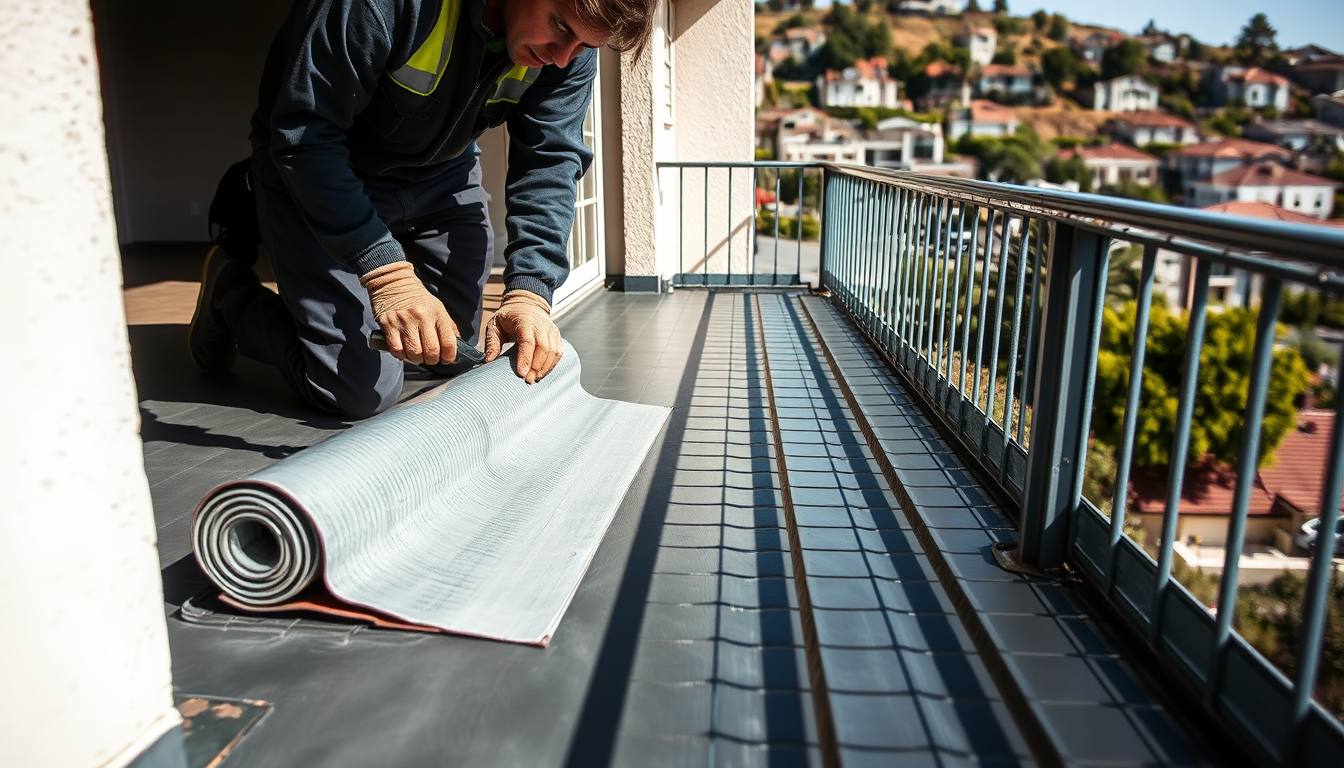
Here’s the short answer. The best way to waterproof a balcony is the system that matches your substrate, your traffic and your appetite for maintenance, installed over framing you’ve opened up and confirmed dry. On plywood-framed balconies and walkways in Los Angeles and Orange County, that usually means a lath-and-cement deck system. On concrete, a fluid-applied urethane. On a clean plywood deck that needs to go back in service fast, PVC sheet. All three fail in the same places when the prep is wrong.
Key takeaways
- Slope decides everything. IIBEC quotes IBC Section 1402.3: balconies and similar weather-exposed surfaces “shall be waterproofed and sloped a minimum of ¼ in. unit vertical in 12 units horizontal (2% slope) for drainage.”
- A liquid membrane is not a finished floor. Pacific Polymers lists “Do not use as an exposed or wearing surface” under Limitations for Elasto-Deck BT, and states the membrane “is not UV stable.”
- PVC sheet buys predictable thickness and no recoat cycle. Duradek Ultra is a nominal 60 mil sheet with a manufacturer 15 year waterproofing warranty and “no re-coating needed.”
- Lath systems build a hard, concrete-feeling floor over rough plywood at about 2½ lbs per square foot, and they ask for resealing every 3 to 5 years.
- On an SB 721 or SB 326 building, the statute covers the waterproofing system, not just the beams. The brand matters far less than whether the tear-off reached sound wood.
Capital Deck & Stair is a family-owned California licensed contractor (CSLB #1005325). We’ve opened up decks, balconies and exterior stairways across LA and Orange County for more than 40 years. Every spec and code reference below comes from a published document we pulled and linked. We don’t publish prices, because estimates are site-specific and free. None of this is legal advice.
What Is the Best Way to Waterproof a Balcony? Start Under the Old Coating
Two conditions decide whether any system lasts: positive slope to drainage, and dry, sound sheathing underneath. Get those wrong and the product on top barely matters.
On slope, the requirement is not a suggestion. IIBEC, the building enclosure consultants’ institute, quotes IBC Section 1402.3: “Balconies, landings, exterior stairways, occupied roofs and similar surfaces exposed to the weather and sealed underneath shall be waterproofed and sloped a minimum of ¼ in. unit vertical in 12 units horizontal (2% slope) for drainage” (IIBEC, Horizontal Above-Grade Waterproofing). Manufacturers write the same number into their own specs. Westcoat’s ALX Standard specification states “Slope must be a minimum of ¼ inch per linear foot and shall provide for proper drainage.”
The substrate rules are just as blunt. That same Westcoat spec requires “minimum 5/8 inch (¾ inch preferred) CDX or exterior grade” plywood, a “maximum joist span of 16 inches,” and deflection “less than L/360.” It says flatly that “OSB is not a suitable substrate for this material.” Westcoat defines dry plywood as “less than a 10% moisture reading” (Westcoat ALX Standard Finish System Specification, rev. 12/25).
So what happens when a coating goes over a deck that flunks those checks? It looks perfect for two winters. Then it telegraphs every seam and soft spot. That describes most of the balcony repair calls we take.
Liquid Applied Membrane: Where Does It Fail First?
A liquid applied membrane fails first at its thin spots: inside corners, the base of railing posts, and the last few feet before a drain. Pacific Polymers specifies “A minimum dry film thickness of 60 mils (1.5mm)” for Elasto-Deck BT. Anywhere a crew stretched the material below that number is where water gets through first.
Fluid-applied urethane earns its keep on concrete decks, on complicated shapes with lots of penetrations, and anywhere a sheet layout would be more seam than field. A crew brushes, rolls or squeegees it on. It cures into one continuous film with no laps to weld. Its weak point is thickness control. The membrane is only as thick as the installer made it that day.
Thickness is the whole argument
Pacific Polymers spells out what thick enough means. Its Elasto-Deck BT data sheet calls for “A minimum dry film thickness of 60 mils (1.5mm)” over all surfaces. Coverage “to obtain 60 dry mils” runs “20 sq. ft. /gallon.” You get there “in two coats at 45 sq. ft. /gallon per coat, allowing for an overnight cure (12-16 hours) between coats.” The sheet also requires that “All cracks over 1/16″ (1.6mm) in width must be filled and covered with a single or two component urethane sealant” (Pacific Polymers Elasto-Deck BT Technical Data Sheet, Holcim, 11/10/2023).
Liquid systems also punish a flat deck harder than anything else. Standing water sits right on the membrane instead of running off a shingled lap. That is why we check slope before we ever price a coating.
Elasto-Deck BT Type 2 and What “Type 2” Actually Means
Elasto-Deck BT Type 2 is the vertical grade, not an upgraded horizontal grade. The data sheet splits the product plainly: “Type I: For horizontal surfaces. Type II: For vertical surfaces.” Type II has a thixotropic consistency, so it hangs on a wall without sagging, and Pacific Polymers notes it “may be used on vertical as well as horizontal surfaces.” People searching for the Type 2 product often want it for a deck field. On a flat deck, Type I is the horizontal grade.
Two lines in that data sheet matter more than any performance number. Under Limitations: “Do not use as an exposed or wearing surface.” And separately: “ELASTO-DECK B.T. is not UV stable, for best performance membrane needs to be protected from UV exposure within 14 days.” On a Van Nuys job site in August, that means the black membrane you see on day one is not your finished balcony. Leaving it open to the sun past two weeks is a defect, not a scheduling detail. It still needs a wearing course over it.
None of that makes it a weak product. The cured film stays “flexible from –75°F to +175°F” and meets ASTM C836/C836M. It carries Los Angeles Research Reports RR 24350 and RR-5271, so LA plan check knows it well. Just don’t mistake the membrane for the floor.
PVC Sheet Membrane: Factory Thickness, Hand-Made Seams
PVC sheet trades field-mixed variability for factory consistency. You get a known thickness off the roll, and the walking surface arrives with the waterproofing instead of after it. Duradek Ultra is “Calendared polyvinyl chloride (PVC) film laminated to a woven, heat-set polyester fabric,” nominally “0.060 inch [60 mils (1.5 mm)]” thick, 72 inches wide, at 55 oz. per sq. yd. It lists under ICC-ES No. 2151 and ASTM D4434, Type II (Duradek Ultra PVC Sheet Membrane Product Data Sheet).
The maintenance story is the real draw. Duradek lists “Only maintenance is occasional cleaning (no re-coating needed),” a 15 year waterproofing warranty, a 5 year appearance warranty, and “Useable immediately after installation (no curing time).” For an occupied second-floor unit where the tenant needs the balcony back tomorrow, that matters.
So what do you trade? Seams and terminations. Every lap, every post boot, every transition to the door pan is a joint somebody made by hand. Duradek’s own sheet says installers must be “authorized and trained contractors using sound roofing details.” That’s the polite way of saying the product won’t forgive improvisation. Sheet also telegraphs a lumpy substrate. A proud fastener head or a raised plywood seam shows through as a ridge, and that ridge becomes the first wear point.
Lath and Metal Mesh Systems: The Cementitious Deck LA Apartment Buildings Get
Lath systems are the workhorse on wood-framed apartment walkways here, because they build a hard, monolithic floor over plywood that isn’t pretty. You stack the buildup rather than spray it: plywood, sheet membrane, metal lath, then base coat, slurry coat, texture coat and topcoat. Westcoat describes its ALX Standard as “a waterproof walking deck system” that “contains a reinforcing lath and is installed with a series of three separate polymer-modified cementitious applications and sealed with Westcoat’s SC-10 Acrylic Topcoat,” weighing “approximately 2½ lbs per square foot.”
The lath does structural work for the cement, and the spec treats it that way. You can use either “WP-25 Metal Lath or WP-30 Westcoat Glass Lath,” stapled at “16-20 staples per square foot.” Westcoat recommends WP-30 “For maximum protection against corrosion.” The spec calls out flashing at “a minimum of 26-gauge bonderized sheet metal.” At the junction of the wall and deck it requires “4 x 6 inch ‘L’ flashing.” On a coastal Orange County building, that corrosion note is not academic. Salt air eats galvanized lath from inside the deck outward, and nobody sees it until the topping starts spalling.
These systems handle rehab well. Westcoat notes ALX “can be stapled through most old deck systems,” which is how crews cover tired magnesite and worn coating instead of removing it. That’s convenient. It’s also the exact shortcut that gets buildings in trouble when the wood below is already wet. Our deck coating and sealing crews cut a test area first for that reason.
How Do the Three Deck Waterproofing Systems Compare?
There is no single best way to waterproof a balcony that wins on every building. The three main deck waterproofing systems differ most in what they forgive. Liquid urethane forgives complicated shapes but not thin application. PVC sheet forgives nothing about a lumpy substrate but needs no recoat. Lath and cement forgives a rough deck but wants resealing every 3 to 5 years. Here is the side by side.
| Factor | Liquid applied urethane | PVC sheet | Lath and cement |
|---|---|---|---|
| Best substrate | Concrete, sound plywood | Flat, clean plywood | Rough or seam-heavy plywood |
| Fails first at | Thin spots, inside corners | Seams and terminations | Topcoat wear, lath corrosion |
| Tolerates an uneven deck | Moderate | Poor | Best |
| Added weight | Minimal | Minimal | About 2½ lbs per sq ft (Westcoat ALX) |
| Maintenance cycle | Topcoat dependent | Cleaning only, “no re-coating needed” (Duradek) | Inspect every 2 to 4 years, reseal every 3 to 5 (Westcoat) |
| Return to service | Overnight cure between coats, 12 to 16 hours (Pacific Polymers) | “Useable immediately after installation” (Duradek) | Multi-day, coat by coat |
Every figure in that table comes from the manufacturer document linked in the section above it. Nothing there is our estimate.
Where Do Balconies Actually Leak? Railing Posts and the Door Threshold
Ask any installer where balconies leak and you’ll hear the same two answers. It isn’t the middle of the deck. It’s the railing post penetration and the door threshold, and each system handles them differently.
Railing post penetrations
A through-bolted or core-set post is a hole in your membrane that moves every time somebody leans on the rail. Liquid systems handle this best. You can build reinforced fabric up and around the base as one continuous detail. Pacific Polymers allows for exactly that: “Some applications may require fabric reinforcement at penetrations or transitions.” PVC sheet needs a fabricated boot bonded to the field sheet. Lath systems need the membrane and flashing detailed at the post before any cement goes down. Once three cementitious coats sit over a bad post detail, the repair becomes a demolition.
Better yet, skip the deck penetration and fascia-mount the rail. That isn’t always possible on an existing building with an approved rail height and an inspector’s report in hand. It’s still the first question worth asking.
The door threshold
The threshold is where interior floor height fights exterior drainage. You need the membrane turned up behind the door pan, the deck sloped away, and enough height difference to do both. A thick assembly hurts here. A lath system adds real height at the door, and on a retrofit that can eat the step-down you had. Sheet and liquid systems stay thinner at the transition. That’s one honest argument for them on a building with a tight threshold.
Which System Tolerates a Substrate That Isn’t Perfectly Flat?
Lath wins this one, and it isn’t close. A base coat troweled over lath buries plywood seams and produces a flat plane where none existed. Westcoat markets the system for exactly that, calling ALX “ideal for areas with heavy traffic or in cases where elimination of the appearance of plywood seams is essential.” Its base coat goes down at 40 square feet per batch, troweled “to the top of the lath.” That’s how the assembly builds thickness where the deck sits low.
Liquid membrane comes next. It flows into pores and hairline cracks, but it follows the deck’s shape. A dished area stays dished and holds water. PVC sheet forgives the least. Anything proud of the plane shows, and a low spot becomes a puddle with a seam running through it. Is your existing deck wavy and you’d rather not re-sheet it? That’s the case for a cementitious lath system.
How Long Does a Deck Coating Really Last in Southern California Sun?
Service life tracks the recoat schedule, not the warranty. Westcoat’s ALX specification calls for inspecting the system “every 2 to 4 years” and resealing it “every 3 to 5 years depending upon traffic and UV exposure.” Duradek’s PVC sheet is the exception, carrying a manufacturer 15 year waterproofing warranty with “no re-coating needed.”
Southern California is harder on deck waterproofing systems than the brochures suggest, because our weather does two damaging things in sequence. Eight or nine months of direct UV bake the topcoat and drive off its elasticity. Then a handful of concentrated winter storms load the deck with more water in three weeks than some climates see all year. UV opens the coating, and rain finds what UV opened.
Skip two of those reseal cycles on a south-facing walkway and the topcoat is gone, the texture coat is chalking, and water has reached the base coat. Even the sheet membrane inside a lath assembly runs a UV clock during construction. Westcoat states WP-40 “may not be left exposed to the sun for more than 7 days.” PVC sheet is the outlier. Duradek builds “UV and mold inhibitors” into the sheet and lists no recoat requirement at all.
Here’s the part nobody puts in a brochure. The number that matters isn’t 15 years or 8 years. It’s whether somebody will actually walk the deck in year three and reseal it. On owner-occupied homes, that mostly happens. On multi-unit properties with turnover in management, it mostly doesn’t, and that argues for a system with no maintenance cycle to forget.
Can You Put Tile Over a Balcony?
Yes, but the waterproofing goes under the tile as a purpose-built assembly, not a coating with tile stuck on top. Tremco describes its Vulkem 350NF with Tremco Epoxy Primer as “an under tile waterproofing system comprised of a tough-curing liquid polyurethane base coat and a highly durable, low-modulus epoxy top coat.” Tremco lists it as suitable for “concrete, well-anchored AC plywood, and primed metal surfaces,” and “ideal for tiles, pavers, and bonded overburden.”
The base coat “retains its integrity even if substrate movement causes hair-line cracks of up to 1/16″ (1.5 mm),” and tests at 600 to 700% elongation per ASTM D412. The install conditions are strict. Concrete must “attain a 2500 psi minimum compressive strength.” Moisture content “must be lower than 4.5%.” Under Limitations, Tremco writes “Long-term UV exposure prohibited” (Tremco Vulkem 350NF/Tremco Epoxy Primer Under Tile Waterproofing System TDS). Vulkem 350NF is one of the systems listed on our technical info page. Tile over an unwaterproofed deck is the most expensive mistake we tear off, because the tile hides the leak until the framing is gone.
Do SB 721 and SB 326 Care Which System You Pick?
They don’t. This is the point no manufacturer will make. On a covered multifamily building, your system choice matters less than whether the tear-off reached sound substrate, because California’s inspection statutes don’t grade coatings. They grade the assembly.
What the two statutes actually inspect
SB 721, at Health and Safety Code section 17973, defines “associated waterproofing elements” as “flashings, membranes, coatings, and sealants that protect the load-bearing components of exterior elevated elements from exposure to water and the elements.” It requires those elements to be “in a generally safe condition, adequate working order, and free from any hazardous condition caused by fungus, deterioration, decay, or improper alteration” (California Health and Safety Code § 17973).
SB 326, at Civil Code section 5551, defines the inspected element as “the load-bearing components together with their associated waterproofing system.” It asks the inspector to determine whether “unintended water or water vapor has passed into the associated waterproofing system, thereby creating the potential for damage to the load-bearing components” (California Civil Code § 5551).
Read those two definitions again. A brand-new coating over saturated plywood satisfies neither one. It’s a cosmetic repair on a documented finding, and it comes back at the next cycle.
On timing, both initial deadlines sit behind us as of this writing in August 2026. For apartment buildings under SB 721, AB 2579 (Chapter 835, approved September 28, 2024) moved the first inspection date. Section 17973(d)(1) now reads “The inspection shall be completed by January 1, 2026, and by January 1 every six years thereafter” (California AB 2579, 2023-2024 session). The Legislature amended section 17973 again through AB 130 (Stats. 2025, Ch. 22), effective June 30, 2025.
For condominium associations under SB 326, the initial deadline was January 1, 2025. Inspections run “every nine years thereafter in coordination with the reserve study inspection.” Confirm your building’s obligations and any local amendments with your inspector, your city building department, or your association’s counsel. Our SB 721 and SB 326 compliance work starts from the inspector’s report and runs through permits to sign-off.
How We Pick a System on a Walk-Through
We settle on the best way to waterproof a balcony standing on the deck, not out of a catalog. Four questions, in this order:
- What’s the substrate: concrete, sound plywood, or something we have to replace?
- How flat is it, and does it drain at ¼ inch per foot or better?
- How many penetrations, and can you eliminate any of them?
- Who will maintain it in year three?
Concrete with good slope points to fluid-applied. Rough or seam-heavy plywood on a multi-unit walkway points to lath and cement. A clean plywood deck on a home where the owner wants it back in service the same week points to PVC sheet. Tile means an under-tile assembly from the start. A deck with soft spots points to deck repair or reframing before anybody talks about membranes. Exterior stairs get their own treatment, since treads, nosings and stringers fail differently than a flat deck does. You can see the systems and specs we work with on our technical info page.
Is your balcony soft underfoot, staining the ceiling below, cracking at the rail posts, or showing up on an SB 721 or SB 326 report? Call Capital Deck & Stair at 818-697-6334 or request a free on-site estimate. We’ll cut a test area, tell you what the framing actually looks like, and spec the assembly from there. Most projects are backed by our 8-year workmanship warranty.
Sources and Retrieval Dates
Last reviewed August 10, 2026. Every spec, date and quoted line above traces to one of these published documents, and we pulled and read each one that day. Manufacturer data sheets get revised, and statutes get amended, so check the current version before you write a scope from any of them.
- Pacific Polymers Elasto-Deck BT Technical Data Sheet, Holcim Solutions and Products US, LLC, revision dated 11/10/2023. Retrieved August 10, 2026.
- Duradek Ultra PVC Sheet Membrane Product Data Sheet, Duradek US Inc. Retrieved August 10, 2026.
- Westcoat ALX Standard Finish Waterproofing System Specification, revision 12/25. Retrieved August 10, 2026.
- Tremco Vulkem 350NF/Tremco Epoxy Primer Under Tile Waterproofing System Technical Data Sheet. Retrieved August 10, 2026.
- IIBEC, Horizontal Above-Grade Waterproofing, quoting IBC Section 1402.3. Retrieved August 10, 2026.
- California Health and Safety Code § 17973 (SB 721, as amended). Retrieved August 10, 2026.
- California Civil Code § 5551 (SB 326). Retrieved August 10, 2026.
- California AB 2579 (2023-2024), Chapter 835, approved September 28, 2024. Retrieved August 10, 2026.
Frequently Asked Questions
What is the best waterproofing for a wood-framed balcony?
For a wood-framed balcony over living space, a lath-reinforced cementitious deck system is the most common choice in Los Angeles and Orange County. It produces a hard walking surface over plywood that isn’t flat. Westcoat’s ALX Standard is a representative example: plywood, sheet membrane, metal or glass lath, then base, slurry, texture and topcoat, at roughly 2½ lbs per square foot. PVC sheet and fluid-applied urethane both work over wood too, as long as the sheathing meets the manufacturer’s requirements. Westcoat requires minimum 5/8 inch CDX plywood, a maximum 16 inch joist span, and deflection under L/360.
Can you waterproof a balcony without removing the existing surface?
Sometimes, and it depends entirely on what sits under it. Some systems go over old decking by design. Westcoat notes that ALX “can be stapled through most old deck systems to provide an excellent method for the rehabilitation of problem surfaces.” That only applies when the substrate below is dry and structurally sound. Say the plywood reads above the manufacturer’s moisture limit, there’s dry rot at the ledger, or the deck sounds hollow when you tap it. Coating over the top traps the moisture, and the new system fails from below.
How long does balcony waterproofing last in Southern California?
Service life depends on maintenance more than product. Westcoat’s ALX specification calls for inspection “every 2 to 4 years” and resealing “every 3 to 5 years depending upon traffic and UV exposure.” Duradek’s PVC sheet takes a different approach, carrying a manufacturer 15 year waterproofing warranty with “no re-coating needed.” A south or west-facing deck in the San Fernando Valley takes far more UV than a shaded north-facing balcony. Two identical installs on the same building can age very differently.
Is Elasto-Deck BT Type 2 the right product for a balcony deck?
Type 2 is the vertical grade. Pacific Polymers’ data sheet states “Type I: For horizontal surfaces. Type II: For vertical surfaces,” with Type II having a thixotropic consistency so it won’t sag on a wall. More important for either type, the data sheet lists “Do not use as an exposed or wearing surface” under Limitations. It also states the product “is not UV stable, for best performance membrane needs to be protected from UV exposure within 14 days.” Treat it as a waterproofing membrane that needs a wearing course over it, not a finished balcony floor.
Does new waterproofing satisfy an SB 721 or SB 326 inspection finding?
Only if you correct the underlying condition. Civil Code section 5551 defines the inspected element as “the load-bearing components together with their associated waterproofing system.” Health and Safety Code section 17973 requires the waterproofing elements to be free of hazardous conditions “caused by fungus, deterioration, decay, or improper alteration.” A new coating over decayed framing meets neither standard. That’s the whole reason our SB 721 and SB 326 compliance scopes start at the framing. Confirm what your specific report requires with the inspector who wrote it and with your local building department.
Is there one best way to waterproof a balcony, or does it depend on the building?
It depends, and any installer who tells you otherwise is selling one product. Three things decide it. What the substrate is, how much foot traffic the deck takes, and who will maintain it in year three. Concrete with good slope points to a fluid-applied urethane. Rough or seam-heavy plywood on an apartment walkway points to lath and cement. A clean plywood deck that has to go back in service quickly points to PVC sheet. What doesn’t change is the prep. All three fail early over wet or rotted sheathing, which is why we cut a test area before we spec anything.