
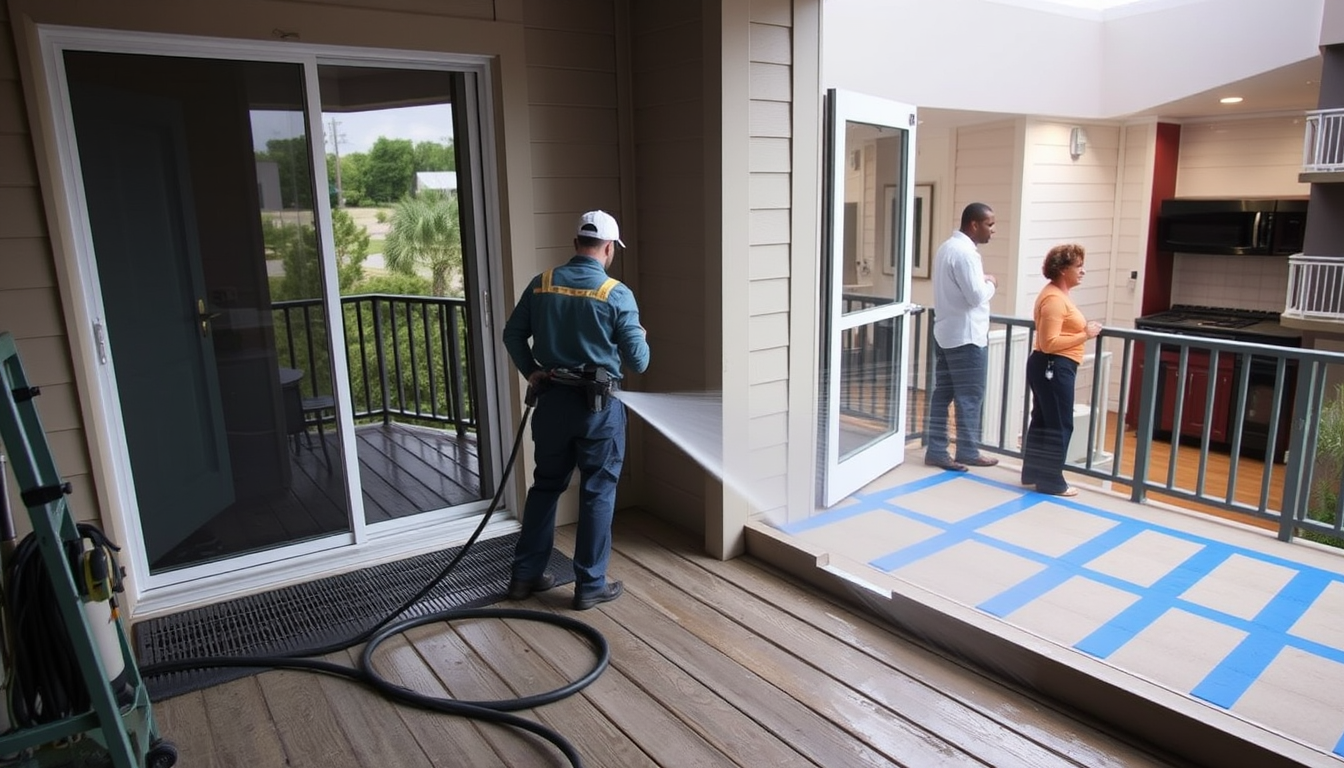
Water intrusion at a deck or balcony gets proven by staged testing, not by looking at a stain and guessing. You wet one detail at a time, starting at the lowest suspected point, and watch for water below. When a detail leaks on cue and its neighbors stay dry, you’ve found the source. Then you can fix it once.
This guide was written by the field team at Capital Deck & Stair Waterproofing, a licensed (#1005325), family-owned LA and Orange County contractor with 35+ years on decks, balconies and stairs. It was last updated October 26, 2026.
That’s the part most pages skip. Leak detection outfits sell the test and stop there. Defect law firms describe the damage in courtroom terms. Neither tells you how a waterproofing contractor actually runs the test, reads the results and turns them into a repair scope. This guide does, for LA and Orange County owners, property managers and HOA boards.
Key Takeaways
- Test from the bottom up. ASTM E2128 says starting at the bottom “helps eliminate ambiguity about the origin of a leak” (IIBEC, 2022).
- Change one variable per test, and log every run with time, location and result.
- A moisture reading shows where water is, not how it got there. Wood below 20% moisture content won’t decay, per a 2002 paper co-authored at the USDA Forest Products Laboratory.
- When tests stop narrowing it down, a small exploratory opening is usually the faster answer.
- As of October 26, 2026, the first SB 721 and SB 326 inspection deadlines have both passed. Keep test records with your inspection reports.
What Is Water Intrusion Testing on a Deck or Balcony?
Water intrusion testing is a controlled way to recreate a leak so its entry point can be proven. Building enclosure consultants split water testing into two kinds. Performance testing checks a new installation. Diagnostic testing “is used to evaluate observed water intrusion and attempts to re-create leakage” (IIBEC, Intricacies of Water Testing, 2022).
On a balcony, diagnostic testing is the one that matters. Something already leaked. A ceiling below is stained, a soffit is soft, or the coating feels spongy underfoot. The test answers one question. Which detail let the water in?
On a wood-framed balcony, the usual suspects are short. Think of the door threshold, the deck-to-wall flashing, rail post penetrations, the scupper or drain, and the field of the membrane itself. On older LA apartment buildings, add cracked magnesite. On tile-over-deck assemblies, add the grout and the membrane hidden under it.
Why Do Blind Balcony Repairs Keep Failing?
A ceiling stain rarely marks where water enters a balcony, so a repair aimed at the stain often misses. Vertex, an engineering firm, wrote in 2023 that even a missing stain doesn’t rule out water intrusion. Wet sheathing can sit behind a dry soffit. Proving the entry point first is what keeps the second repair from failing like the first.
Water rarely shows up where it gets in. It runs along framing, follows the slope of the sheathing and drips at the first low spot. A stain on the ceiling below can sit well away from the real entry point. So the crew recoats the deck, and the leak comes back with the first winter storm.
Southern California makes this worse. A long dry season hides the problem for months. Then a few concentrated storms hit, and everyone wants it fixed this week. That pressure is how owners end up paying for a coating when the failure was a door pan or a flashing lap.
The exact wording from Vertex’s architect is blunt: “the absence of water staining on the ceiling below a balcony does not necessarily mean that water intrusion is not occurring” (Vertex, Balcony Water Intrusion, 2023). Isn’t the leak with no stain the one you most need to find?
What Happens Before Any Water Goes On?
Before any hose comes out, the investigator reviews the building. The ASTM E2128 guide lists four steps ahead of testing. Those are reviewing available documents, evaluating the design concept, learning the maintenance and service history, and observing existing conditions (IIBEC, 2022). Skip them and you test the wrong things.
In practice, that review on a balcony job looks like this:
- Leak history. Does it leak only in rain, or all the time? A constant leak points to plumbing or irrigation, not the deck.
- Past repairs. Who recoated it, when, and with what system? A fresh topcoat can hide an old flashing problem.
- Drawings and reports. Pull any SB 721 or SB 326 inspection report, permits and plans you have.
- Visual survey. Check slope, ponding stains, cracks in the topcoat, loose rail posts and the condition of the door sill.
The review can also clear the deck. ASTM’s guide notes that water may come from “a roofing problem, a condensation problem, a plumbing problem, operable windows or doors left opened or unlatched” (ASTM E2128-20). That’s worth knowing before you pay for a deck test. It’s also why a fresh coat from a deck coating and sealing crew can’t fix a leak that was never in the deck.
How Does Staged Water Intrusion Testing Work?
Staged water intrusion testing wets one suspected detail at a time, starting at the lowest one, and moves up only after each detail passes or fails. ASTM E2128 says starting at the bottom “helps eliminate ambiguity about the origin of a leak that might result from water running vertically down the surface of the test area” (IIBEC, 2022).
Step 1: Start at the lowest suspected point
Water runs downhill. If you soak the door head first, it will run down over the sill, the threshold and the deck-to-wall joint. A leak at that point could come from any of them. Starting low means each detail gets tested before water from above can reach it.
On a typical balcony we’d start at the scupper or drain, then the deck edge flashing. After that come the field of the deck, the deck-to-wall flashing, the door threshold and the rail posts. The order changes with the building. The rule doesn’t.
Step 2: Change one variable at a time
Each test isolates one detail. Neighboring areas get masked off or kept dry, and a second person watches the space below. The run is timed. If nothing shows, the tester moves up one stage.
Overspray is the enemy here. IIBEC warns that spraying past the test area “can lead to false positives and misunderstood results.” It also names the “test-induced leak,” water that comes in during a test but never leaks in natural weather (IIBEC, 2022). A hose aimed straight up under a threshold can prove a leak that rain never causes.
Step 3: Match the water to the question
The tool depends on the detail being tested. Here’s how the three common methods compare:
| Method | What it tests | Where it fits on a balcony | Main caution |
|---|---|---|---|
| Spray wand or nozzle | One joint or transition | Deck-to-wall flashing, rail posts, scupper edges | Overspray can wet the next detail |
| Spray rack (ASTM E1105) | A whole door or window unit | Balcony slider and its threshold | Racks deliver 5 gallons per square foot per hour, per IIBEC |
| Flood test (ASTM D5957) | The membrane field | Low-slope deck with drains that can be plugged | Needs a structural engineer to review the water load |
A perforated wand puts a line of water on a single joint. IIBEC calls it particularly useful at transitions such as deck to wall. A flood test does the opposite. It plugs the drains and loads the whole deck at once.
Flood testing has real limits on a wood deck. ASTM D5957 covers surfaces sloped no more than 2 percent (1/4 inch per foot). It caps the water at 4 inches unless a licensed structural engineer approves more. It also calls for that engineer to review the added load (ASTM D5957-98(2021)). On an older balcony with soft framing, that review isn’t optional.
A flood test is also a blunt diagnostic tool. IIBEC’s review says flood testing used to diagnose a leak “is generally ineffective.” It shows that a problem exists but not where it is, unless each penetration, transition and area is isolated and tested separately. When flooding isn’t practical, the same review points to electronic leak detection under ASTM D7877 and ASTM D8231 (IIBEC, 2022).
The same review says ASTM D5957 “should primarily be used as a performance assessment.” That’s why a staged spray sequence usually comes first on a leaking balcony, and a flood test, if one is run at all, fits better as a check on new waterproofing.
What Do Moisture Readings Prove, and What Don’t They?
A moisture reading proves where water is sitting today. It doesn’t prove where the water got in. Morris (Forintek Canada) and Winandy (USDA Forest Products Laboratory) put the line plainly in 2002. Wood “will decay above 30% moisture content and will not decay below 20%.” The range between is a grey area (Morris and Winandy, Limiting Conditions for Decay in Wood Systems, 2002).
That makes a moisture map useful. Readings taken on a grid at the soffit or through small holes show where the wet wood is and how far it spreads. Readings above 30% at the ledger tell you the wood has been sitting in decay conditions.
But a map has blind spots:
- Wet spots travel. The wettest reading may sit downhill of the leak, not under it.
- Old rot can stay active. The same paper says existing decay “may continue until the wood is dried below 20%.” Decay also produces water, so rotten wood can read wet after the leak stops.
- Tools have limits. Even the ASTM E1105 field test “does not identify unobservable liquid water” that gets into an assembly (ASTM E1105-15(2023)).
California’s SB 326 statute names the same toolkit. Civil Code 5551 lists “moisture meters, borescopes, or infrared technology” as visual inspection aids (Civil Code 5551). They screen. A water test or an opening confirms.
When Does an Exploratory Opening Beat Another Test?
An exploratory opening beats another test when the tests have stopped narrowing things down. ASTM’s leak guide says investigation techniques “may be intrusive, disruptive, or destructive.” It tells the investigator to plan for patching ahead of time (ASTM E2128-20).
We’d open the assembly in these situations:
- Two or more details fail together and you can’t separate them with water.
- Moisture readings are high, but no test reproduces the leak.
- The deck feels soft underfoot, which points to sheathing or framing damage.
- Tile, a topping slab or magnesite hides the membrane, so you can’t see what you’re testing. Vertex notes that rotted plywood under a concrete topping slab “may not necessarily translate into cracking of the concrete,” so the surface can look fine over real damage.
Vertex’s own advice lands in the same place. It names “thermal imagery and limited deconstructive evaluations” as the techniques that make it “possible to determine with certainty if water intrusion is occurring” (Vertex, 2023). A limited deconstructive evaluation is just a planned opening with a name on it.
An opening is small and planned. We cut at the suspect detail, usually the deck-to-wall joint or the door threshold. We photograph each layer on the way down: topcoat, membrane, flashing, sheathing, then framing. What turns up most often is failed flashing laps, saturated plywood and dry rot at the ledger. Then the opening gets temporarily protected until the repair.
Why keep spraying water on a question that one small, planned cut can answer?
How Do Test Results Become a Repair Scope?
Test results become a repair scope when each confirmed failure is tied to a specific fix. A good scope lists the detail that failed, the evidence that proved it, the damage found behind it, and the repair. A vague line like “recoat balcony” isn’t a scope. It’s a guess with a price on it.
A scope built from staged testing usually reads in assembly order:
- Remove and replace rotted sheathing and framing found at the opening, with an engineer’s direction if load-bearing members are involved.
- Rebuild the failed flashing at the wall or threshold, lapped so water drains out, not in.
- Correct slope where ponding was observed. Vertex notes that balconies should ideally slope 1/4 inch per foot (Vertex, 2023).
- Install the membrane and traffic coating per the manufacturer’s specifications.
- Retest the repaired detail before the finish goes on.
On SB 721 buildings, the scope has outside rules too. Health and Safety Code 17973(g) requires repairs by “a qualified and licensed contractor,” with permits from the local jurisdiction. The work must follow the recommendations of a licensed professional described in subdivision (a), any applicable manufacturer’s specifications, the California Building Standards Code and local requirements (HSC 17973). For what the finished system looks like, see the waterproofing systems we install. For the repair itself, see our balcony leak repair page.
What Water Intrusion Records Should an Owner or HOA Keep?
Keep every test log, photo and moisture map with your inspection reports. California’s SB 721 statute requires the inspector’s report to include “photographs, any test results, and narrative sufficient to establish a baseline” (HSC 17973(c)(4)). Your water test records feed straight into that baseline.
A complete water intrusion file holds:
- A marked-up plan showing each test location and its sequence number.
- For each test: date, weather, method, duration, who watched below, and the result.
- Photos of the setup, the interior during the test, and each layer of any opening.
- Moisture readings with locations, and the meter used.
- The final scope, permits and completion photos.
Why so much paper for a diagnostic test? IIBEC’s answer is that troubleshooting can use almost any water method, “so long as the conclusion reasonably reflects the observations and is properly documented” (IIBEC, 2022). The log is what turns a hose test into evidence a board, an inspector or a warranty claim can rely on.
Here’s where the statutes stand as of October 26, 2026. This isn’t legal advice, so confirm specifics with your inspector, your city or counsel.
- SB 721 (apartments). HSC 17973(d)(1) requires inspection “by January 1, 2026, and by January 1 every six years thereafter.” AB 2579 (Chapter 835, approved September 28, 2024) moved that from January 1, 2025. That deadline has passed. Reports must be kept for at least two inspection cycles and handed to a buyer at sale. The section was last amended by AB 130 (Stats. 2025, Ch. 22).
- SB 326 (condominium HOAs). Civil Code 5551(i) set the first inspection for January 1, 2025, then every nine years with the reserve study. That deadline has also passed. Reports stay with association records for two cycles. SB 410 (Stats. 2025, Ch. 516) amended the section effective January 1, 2026.
Our SB 721 and SB 326 compliance work starts from the inspector’s findings and carries through permits and sign-off.
When Should You Call a Water Intrusion Specialist?
Call a water intrusion specialist when a leak has survived one repair, when the deck feels soft, or when an inspection report flags waterproofing. Those are the cases where guessing costs the most. A second recoat over a failed flashing just buries the problem for another winter.
The ASTM E2128-20 leak guide says the evaluator needs “a knowledge of basic physics and of construction and wall design principles and practices” (ASTM E2128-20). On a balcony, that means someone who knows how flashing, membrane, sheathing and framing fit together. A hose and a moisture meter alone don’t make a diagnosis.
An honest specialist will also tell you what testing can’t promise. The same ASTM guide says that since every location isn’t tested, “it is probable that every leak source will not be identified,” and it warns that results “should not be over-represented” (ASTM E2128-20). On a balcony, that’s one more reason to retest the repaired detail before the finish goes on.
A good water intrusion specialist will explain the test sequence before starting. They’ll keep a written log and tell you when an opening makes more sense than another round of water. They should also be able to do the repair, so the same crew owns the result.
Capital Deck & Stair Waterproofing is a family-owned contractor, licensed (#1005325) and insured. You can read more about our team. We’ve worked on decks, balconies and exterior stairs across Los Angeles and Orange County for 35+ years. Most projects are backed by an 8-year workmanship warranty. If your balcony or deck matches what’s described here, call us at 818-697-6334 for a free on-site estimate. You can also request a quote online.
Frequently Asked Questions
How long does a balcony water test take?
It depends on how many details are tested. Each stage is a timed run on one detail, then a check below. A flood test under ASTM D5957 holds 1 to 4 inches of water for 24 to 72 hours, according to IIBEC’s 2022 review of water testing methods. Spray stages on single joints are much shorter.
Can a moisture meter find the source of a leak by itself?
No. A meter shows where water is sitting, not where it entered. A 2002 paper co-authored at the USDA Forest Products Laboratory says wood decays above 30% moisture content and won’t decay below 20%. A high reading tells you the wood is at risk. A staged water test or an opening tells you why.
Is flood testing safe on an old wood balcony?
Not without a structural check. ASTM D5957 calls for a licensed structural engineer to review the added water load, and it caps standing water at 4 inches without that engineer’s approval. It’s also limited to surfaces sloped 2 percent or less. On a soft or rotted balcony, spray testing or an opening is usually safer.
What is a test-induced leak?
A test-induced leak is water that gets in during a test but would never get in during normal weather. IIBEC uses the term for diagnostic tests that produce leakage “not observed from natural causes.” It usually comes from aiming high-pressure water where rain never reaches, such as straight up under a door threshold.
Do SB 721 inspections include water testing?
Not necessarily. HSC 17973(c)(2) calls for assessment by “direct visual examination or comparable means.” But the report must include “any test results” that were done. For condos, Civil Code 5551(d) lets the inspector go further when conditions show water has passed into the waterproofing system. Confirm scope with your inspector.
Sources
Last updated October 26, 2026. Every statutory line above was read from the official text on leginfo.legislature.ca.gov on that date. Standards details come from the ASTM store pages listed below.
- IIBEC, Intricacies of Water Testing (Melany Elwell), February 4, 2022, retrieved 2026-10-26, iibec.org
- ASTM International, E2128-20 Standard Guide for Evaluating Water Leakage of Building Walls, retrieved 2026-10-26, store.astm.org
- ASTM International, D5957-98(2021) Standard Guide for Flood Testing Horizontal Waterproofing Installations, retrieved 2026-10-26, store.astm.org
- ASTM International, E1105-15(2023) Field Determination of Water Penetration of Installed Exterior Windows, Skylights, Doors, and Curtain Walls, retrieved 2026-10-26, store.astm.org
- Morris and Winandy, Limiting Conditions for Decay in Wood Systems, USDA Forest Products Laboratory, IRG/WP 02-10421, 2002, retrieved 2026-10-26, fpl.fs.usda.gov
- Vertex, Balcony Water Intrusion: Steps for Multi-family Property Owners and Managers (Matthew Click, AIA), February 27, 2023, retrieved 2026-10-26, vertexeng.com
- California Legislative Information, Health and Safety Code 17973, retrieved 2026-10-26, leginfo.legislature.ca.gov
- California Legislative Information, AB 2579 (Chapter 835, 2024), retrieved 2026-10-26, leginfo.legislature.ca.gov
- California Legislative Information, Civil Code 5551, retrieved 2026-10-26, leginfo.legislature.ca.gov