
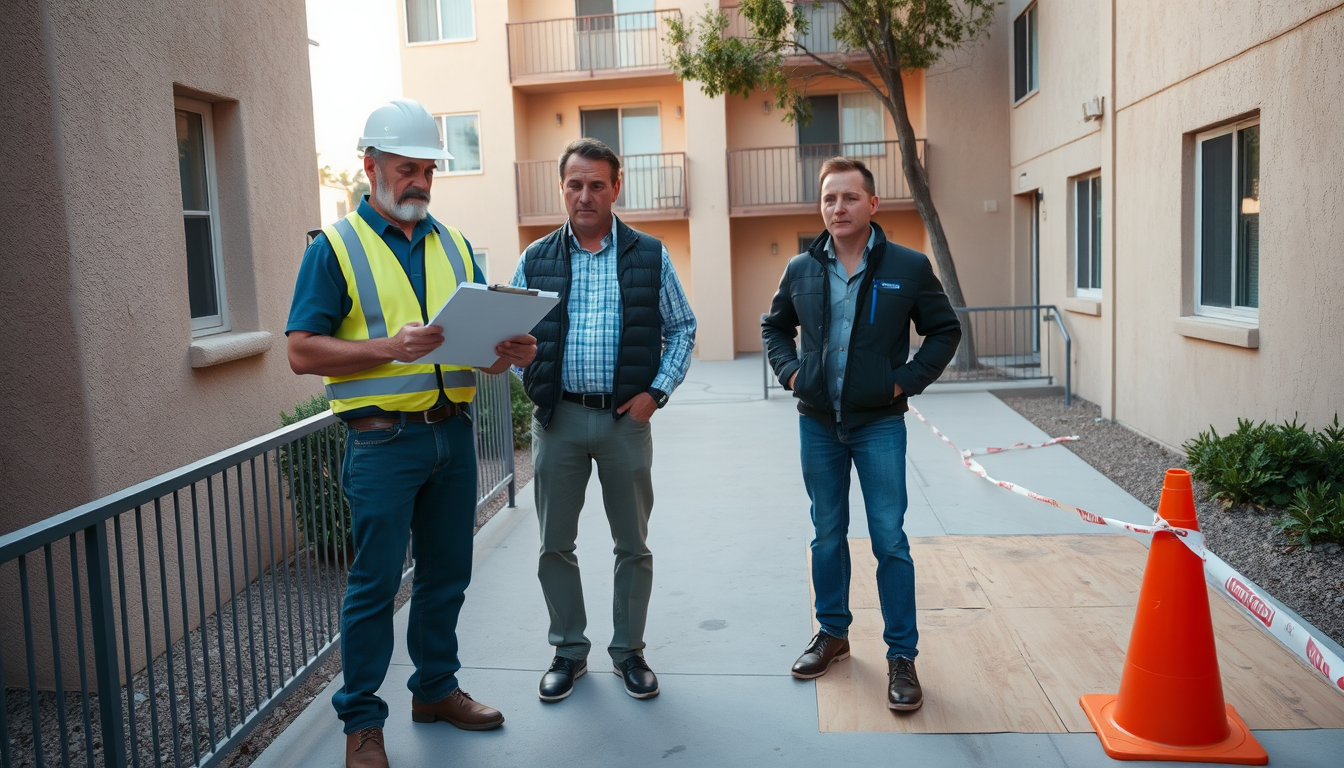
A balcony law contractor is the licensed contractor who takes an SB 721 or SB 326 inspection report and turns it into finished, permitted, signed-off repairs. The inspector’s job ends at the report. Ours starts there.
First, we read each finding into a scope of work and sort structural items from waterproofing items. Then we pull the permit and stage the work around the people who live in the building. Finally, we hand back a file that shows the job was done right. Here’s how that sequence actually runs in Los Angeles and Orange County.
Key Takeaways
- For non-emergency SB 721 findings, Health and Safety Code 17973(h)(2) gives the owner 120 days from receiving the report to apply for a permit, then 120 days after approval to finish repairs.
- Structural findings (load-bearing components) and waterproofing findings (flashings, membranes, coatings, sealants) need different scopes, but the crew should fix them as one assembly.
- Repairs must follow the inspector’s recommendations, manufacturer specifications, the California Building Standards Code and local rules.
- Close-out paperwork is part of compliance, not an afterthought.
A note on dates: as of September 21, 2026, both first-round deadlines have passed. SB 326 condo inspections were due January 1, 2025. In 2024, AB 2579 moved the SB 721 apartment deadline to January 1, 2026. Section 17973 was amended again in 2025 (Stats. 2025, Ch. 22), and the repair rules quoted below are from that current text. This article summarizes what the statutes say. It isn’t legal advice. Confirm your timelines with your inspector, your city’s building department and, if needed, your attorney.
What Does a Balcony Law Contractor Do After the Inspection Report?
Health and Safety Code 17973(g) says every flagged element “shall be corrected by the owner of the building.” The work needs local permits, and it must be “performed by a qualified and licensed contractor” (California Legislative Information, HSC 17973). A balcony law contractor is that licensed contractor. The report tells you what’s wrong. The contractor figures out how to fix it, legally.
That sounds simple. It isn’t. The inspector writes the report to set a condition baseline, not to price or sequence a repair. Section 17973(c)(4) requires “photographs, any test results, and narrative sufficient to establish a baseline.” You won’t find a board count, a flashing detail or a phasing plan in it. So who writes those? The contractor does, working from the inspector’s recommendations.
At Capital Deck & Stair, that’s the whole job. We hold California license #1005325 and have 40+ years on LA and OC decks, balconies and stairs. Our SB 721 and SB 326 compliance repairs follow one path. We scope from your findings, pull the permit, repair and waterproof the elements, schedule the city inspections and see it through to final sign-off.
When Does the Repair Clock Start?
The clock starts when the owner receives the report. For SB 721 apartment buildings, Health and Safety Code 17973(h)(2) sets 120 days to apply for a permit. Once the city approves it, the owner has 120 more days to finish, unless the local enforcement agency grants an extension. Here’s the full sequence as written in the statute:
- Report delivery: the inspector presents a stamped or signed report within 45 days of completing the inspection (17973(c)(4)).
- Emergency copy: if the report finds an immediate threat, the inspector sends it to the owner and the local enforcement agency within 15 days of completing the report (17973(d)(1)).
- Permit application: within 120 days of receiving the report (17973(h)(2)).
- Repairs complete: within 120 days of permit approval (17973(h)(2)).
- Enforcement: if repairs aren’t done within 180 days, the inspector notifies the agency and the owner. Thirty days after that notice, a $100 to $500 daily civil penalty can apply. The city can also record a building safety lien (17973(i)(2) and (i)(3)).
Do those two 120-day windows leave room to shop around for months? Not really. A permit application needs a defined scope behind it, so the contractor should be scoping well before day 120.
Condos run on a different track. Civil Code 5551 (SB 326) has no 120-day permit clock. Instead, an immediate-threat finding triggers 5551(g)(1). The association must block occupant access “until repairs have been inspected and approved by the local enforcement agency” (California Legislative Information, Civil Code 5551). Other repair recommendations feed the association’s reserve study under 5551(f).
| After the report | SB 721 (apartments, HSC 17973) | SB 326 (condos, Civil Code 5551) |
|---|---|---|
| Who inspects | Architect, civil or structural engineer, A/B/C-5 contractor with 5 years’ multistory wood-frame experience, or certified building inspector | Licensed structural or civil engineer, or architect |
| Inspection cycle | Every six years | At least every nine years |
| Permit application deadline | 120 days from receiving the report | No statutory permit clock |
| Repair deadline | 120 days after permit approval | No statutory repair clock |
| Immediate threat | Block access or make emergency repairs; the inspector inspects the repairs | Block access until the local enforcement agency inspects and approves repairs |
| Report retention | At least two inspection cycles; delivered to a buyer at sale | Two inspection cycles as association records |
How Do You Turn Findings Into an SB 721 Repair Scope?
An SB 721 repair scope starts by sorting every finding into one of two buckets the statute itself defines. Section 17973(b)(3) defines load-bearing components as those that “extend beyond the exterior walls of the building to deliver structural loads.” Section 17973(b)(1) defines associated waterproofing elements as “flashings, membranes, coatings, and sealants.” Each bucket needs its own scope. Even so, a good balcony law contractor writes both into one document.
Structural Findings
Structural findings are the joists, beams, posts, ledgers, stringers and connections. On older LA apartment buildings, that often means dry rot at the ledger, where the balcony meets the wall. We also see it at the outboard ends of cantilevered joists. Rusted hangers and fasteners show up too. The scope names each location, the members to remove and replace, and any shoring. If the inspector’s recommendations call for an engineer’s repair details, those details become part of the scope.
Waterproofing Findings
Waterproofing findings cover the coating and the membrane underneath it. They also cover flashing at the wall and edge, plus sealants at posts and penetrations. A cracked topcoat on a sound deck may only need a restoration overlay. A tile-over-deck balcony with a failed membrane means the tile comes up. Magnesite decks on older apartment buildings are their own conversation, because the topping can hide saturated plywood.
Here’s what we’ve learned from opening these assemblies: a structural finding is almost always a waterproofing failure that went unnoticed for years. Southern California’s long dry season hides it. Then a few concentrated winter storms push water past a failed flashing, and the sheathing stays wet long after the rain stops. If the scope replaces rotted framing but leaves the original flashing detail, you’ve rebuilt the leak. So we scope both buckets as one assembly, even when the report lists them on separate lines.
The 15 Percent Sample
Section 17973(c)(2) requires inspecting “a sample of at least 15 percent of each type of exterior elevated element.” The report may also recommend further inspection under 17973(c)(3)(C). If the sampled balconies share one failure pattern, the unsampled ones built the same way deserve a look. Ongoing maintenance of every element stays with the owner under 17973(k). A good scope says plainly which elements it covers and which ones the inspector flagged for further investigation.
When Is the Permit Pulled, and Who Pulls It?
The licensed balcony law contractor usually prepares the application and pulls the permit once the scope is set and before repair work starts. Section 17973(g) says “all necessary permits for repair or replacement shall be obtained from the local jurisdiction.” Meanwhile, 17973(o) lets any city or county impose stricter requirements. So Los Angeles, Long Beach and Santa Ana may each ask for different things.
The same subdivision lists four standards the work must meet:
- The recommendations of the licensed professional who did the inspection.
- Any applicable manufacturer’s specifications.
- The California Building Standards Code.
- All local jurisdictional requirements.
Manufacturer specifications are the item most owners skip over. They matter, and a balcony law contractor who ignores them leaves the owner exposed.
Here’s one example. The IAPMO evaluation report for Hill Brothers’ Desert Crete deck system, ER-586, requires a minimum slope of 2 percent. Its Section 4.3 says damaged areas “shall be cleared of all existing material and replaced.” For damaged substrates, someone has to investigate the fire classification and strength properties and submit the results to the building official (IAPMO UES, ER-586). A patch that ignores that clause isn’t a compliant repair. You can see how we document each system on our technical info page.
Can the Inspector Also Be Your Repair Contractor?
The current state statute doesn’t expressly bar it, but we’d still keep the roles separate. The original 2018 SB 721 text said “No recommended repair shall be performed by a licensed contractor serving as the inspector” (SB 721 bill text, 2018). However, the current Health and Safety Code 17973(g) on leginfo no longer carries that sentence. Plenty of web pages still quote the old rule anyway.
What 17973(g) does still require is clear. The owner needs local permits and a qualified, licensed contractor. The work has to follow the inspector’s recommendations, the manufacturer’s specifications, the California Building Standards Code and local rules. None of that changed with the later amendments.
Why keep them separate? The inspector’s final report is only worth something if it comes from someone who didn’t do the work. Before you combine them, check with your city, since 17973(o) allows local rules that go further than the state law. Ask counsel if you’re unsure.
How Is Repair Work Staged in an Occupied Building?
For a balcony law contractor, staging an SB 721 repair means keeping tenants safe and housed while balconies, walkways and stairs are open. First, we close any element the inspector flags as an immediate threat. Section 17973(h)(1) says immediately preventing occupant access “until emergency repairs can be completed constitutes compliance.” That means a physical barrier, not a note on the door.
Under Health and Safety Code 17973(h)(1), blocking occupant access to an element the SB 721 inspector calls an immediate threat counts as compliance until emergency repairs are done. Those emergency repairs must still meet subdivision (g), which covers permits and a licensed contractor. The inspector then inspects them, and the repairs get reported to the local enforcement agency.
From there, we phase the job so it works for the people living there:
- Group by assembly, not by unit number. We open balconies that share a walkway or ledger line together.
- Protect the only way out. If an exterior stair is a unit’s sole exit, it gets its own sequence and temporary access plan. We plan our exterior stair repair work around that first.
- Use the dry season. Open framing during the summer and fall window, and have the membrane down before winter storms arrive.
- Choose the system for the use. Where the substrate is sound, a restoration overlay like Desert Flex means tenants lose minimal access during the work.
- Tell residents early. Written notice per phase, with dates and what they need to move off the balcony.
Does that make the job slower? Sometimes a little. It also keeps tenants informed and the property manager’s phone quiet. On a building with shared walkways, that planning is most of what separates a smooth job from a hard one.
What Paperwork Makes the Sign-Off File Defensible?
For a balcony law contractor, the job isn’t finished when the coating cures. It’s finished when the file proves the work met the report. Section 17973(d)(1) lets the owner request “a final report indicating that any required repairs have been completed” from the inspector. It also requires keeping all inspection reports “for not less than two inspection cycles” and delivering them to a buyer at sale. Civil Code 5551(i) sets the same two-cycle retention for associations.
A complete close-out file should hold:
- The original inspection report and any engineer’s repair details.
- The balcony law contractor’s written scope, tied line by line to each finding.
- The issued permit and the city’s final inspection sign-off.
- Photos of the opened framing, the new flashing and each membrane stage before the next layer covers it.
- Manufacturer product data for the system installed.
- The inspector’s final report, if you requested one.
- Warranty paperwork. Most of our projects carry an 8-year workmanship warranty.
Why the in-progress photos? Section 17973(c)(4) says the report sets a baseline “that can be compared to the results of subsequent inspections.” Section 17973(d)(1) also requires later reports to “incorporate copies of prior inspection reports.” A clean record makes that next inspection easier to pass.
Is Your Situation a Fit for a Balcony Law Contractor?
Are you holding a report with repair findings? Or a balcony, walkway or stair that’s soft, leaking or cracking? Then the next step is a scope. The City of Los Angeles Housing Department also warns that some private businesses send E3 “inspection” notices that look official but aren’t (LAHD, E3-Apartments). Check who you’re dealing with before you pay anyone.
If that matches where you are, call Capital Deck & Stair at 818-697-6334 for a free on-site estimate. Bring the report. We’ll walk the elements with you and tell you what we’d fix, in what order. You can also request a quote online, or read more about our balcony repair work in Los Angeles.
How We Put This Article Together
We pulled the statute text for this article directly from leginfo.legislature.ca.gov: Health and Safety Code 17973, Civil Code 5551, the chaptered text of AB 2579 and the original 2018 SB 721 bill. The manufacturer requirements come from the IAPMO evaluation report for Desert Crete, a system we install. The field observations about ledgers, flashing and staging come from our own crews’ repair work across Los Angeles and Orange County. You can read more about Capital Deck & Stair and our family-run business.
Frequently Asked Questions
How long do I have to make SB 721 repairs after the report?
For findings that aren’t an immediate threat, Health and Safety Code 17973(h)(2) gives the owner 120 days from receiving the report to apply for a permit. After the city approves the permit, the owner has 120 days to finish, unless the local enforcement agency grants an extension. Confirm your exact dates with your inspector and your city.
Do SB 721 balcony repairs need a permit?
Yes, where the local jurisdiction requires one. Section 17973(g) says “all necessary permits for repair or replacement shall be obtained from the local jurisdiction.” Your city decides what counts as necessary and what it wants with the application. A licensed balcony law contractor normally prepares and pulls the permit for the work it performs.
What’s the difference between a structural finding and a waterproofing finding?
Structural findings involve load-bearing components, the members that carry the balcony’s load back to the building (17973(b)(3)). Waterproofing findings involve flashings, membranes, coatings and sealants (17973(b)(1)). In practice they’re linked. Most rotted framing we open sits under a failed flashing or membrane, so we fix both together.
Does SB 326 have the same 120-day repair deadline?
No. Civil Code 5551 doesn’t set a 120-day permit clock. It requires a licensed engineer or architect to inspect at least every nine years. If an element poses an immediate threat, 5551(g)(1) requires the association to block access until the local enforcement agency inspects and approves the repairs.
What documents should I keep after the repairs are done?
Keep the inspection report, your balcony law contractor’s scope, the permit and final inspection sign-off, in-progress photos, product data and the inspector’s final report if you requested one. Section 17973(d)(1) requires keeping inspection reports for at least two inspection cycles and delivering them to a buyer at sale.
Sources
- California Health and Safety Code section 17973, Exterior Elevated Elements: Inspections, retrieved 2026-09-21. leginfo.legislature.ca.gov
- California Civil Code section 5551, Common Interest Developments, Reserve Planning, retrieved 2026-09-21. leginfo.legislature.ca.gov
- California Assembly Bill 2579 (2023-2024), Chapter 835, Inspections: exterior elevated elements, retrieved 2026-09-21. leginfo.legislature.ca.gov
- California Senate Bill 721 (2017-2018), Building standards: decks and balconies: inspection, original bill text, retrieved 2026-09-21. leginfo.legislature.ca.gov
- IAPMO Uniform Evaluation Service, Evaluation Report ER-586, Desert Crete System Walking Deck and Roof Covering System, retrieved 2026-09-21. forms.iapmo.org
- City of Los Angeles Housing Department, E3-Apartments, retrieved 2026-09-21. housing.lacity.gov