
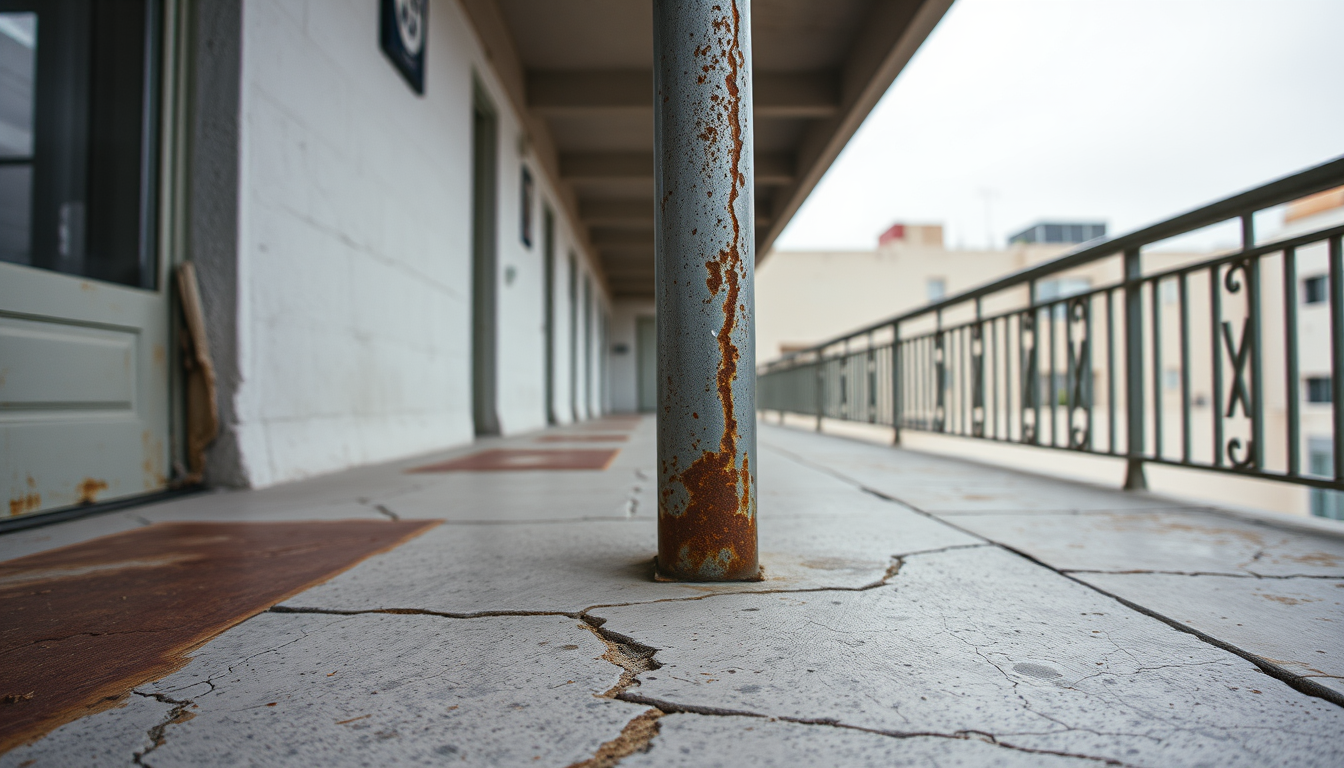
Here’s the verdict before the lecture. Magnesite deck repair is a holding action, not a cure. If the damage is limited to surface crazing, the deck rings solid when you tap it, and the framing underneath is dry, you can patch and recoat and buy a few seasons. If it sounds hollow, if the stair rail posts are swelling out of their embeds, or if the plywood below is soft, you’re looking at tear-off and reconstruction. No coating fixes wet wood.
Key takeaways
- Magnesite is magnesium oxychloride cement, made from calcined magnesite and a magnesium chloride solution mixed with fillers. The UK’s Concrete Society calls it “very vulnerable to dampness.”
- Chloride is the real problem. Chlorides migrate out of the magnesite and corrode adjoining steel, which is why stair rail embeds rust and jack the surface apart.
- Tap testing is the fastest check you can run yourself. Per the Federal Highway Administration, “a clear ringing sound represents a sound deck while a mute/hollow sound represents a delaminated area.”
- Patching is a fair choice on a sound, dry deck with cosmetic damage. It’s the wrong choice once moisture has reached the framing.
- On a building with an SB 721 or SB 326 report, the inspection covers the “associated waterproofing system,” not just the beams. A cosmetic patch usually will not close out the finding.
Capital Deck & Stair is a family-owned California licensed contractor (CSLB #1005325). We’ve been opening up decks, balconies and exterior stairways across Los Angeles and Orange County for more than 40 years, and we tear out a lot of magnesite. Below is the diagnostic sequence we use on a walk-through, plus the statute language that decides the question for multi-unit owners.
On sourcing: the field method here comes from our own crews. Every quoted passage comes from a primary document we pulled on July 30, 2026, and each one is linked where it appears and listed again at the bottom with its retrieval date. We publish no cost figures, because estimates are site-specific and free. None of this is legal advice.
What Is Magnesite, and Why Is It All Over Older LA Buildings?
Magnesite decking is magnesium oxychloride cement, a poured cementitious topping that predates modern fluid-applied membranes. The Concrete Society, the UK concrete technology body, describes it as “a mixture of calcined magnesite and magnesium chloride solution with various fillers (e.g. wood flour, sawdust, asbestos).” It was typically “laid between 10 and 25mm thick” and is “usually a reddish pink colour” (The Concrete Society, Magnesite (Magnesium Oxychloride) Flooring). The same source puts its heyday at 1920 to 1940 for domestic work and 1945 to 1960 for public housing.
That lines up with what we find here. On a lot of mid-century apartment stock in the San Fernando Valley, Koreatown and older Orange County neighborhoods, the second-floor walkways, landings and stair treads are magnesite. It was cheap, noncombustible, took a color, and went down fast over wood framing. It’s also why magnesite deck repair is still a routine line item on buildings from that era.
So why is it failing now? It was never a waterproofing membrane. It was a wearing surface. Southern California runs eight dry months and then a few weeks of concentrated winter storms. Sixty or seventy of those cycles later, the surface has crazed and the joints have opened. The assembly underneath has been taking on water every time it rains.
How Do You Diagnose a Magnesite Deck Before You Spend Anything?
A magnesite deck can be triaged in four checks: tap the surface for hollow spots, inspect the stair rail embeds for rust jacking, tell spalled nosings apart from hairline crazing, and read the framing from underneath. The Federal Highway Administration describes the first one exactly: “a clear ringing sound represents a sound deck while a mute/hollow sound represents a delaminated area.” Cosmetic damage on a sound, dry deck is a patching job. Any sign that water has passed through the topping into wood or steel is not.
Do them in this order. You can run the first three yourself in twenty minutes, and together they decide whether magnesite deck repair means a patch or a rebuild.
1. Tap it and listen for the hollow areas
Work the whole surface with a hammer or a length of chain, especially along the walls and at the outside edge. The Federal Highway Administration states the principle plainly: “A clear ringing sound represents a sound deck while a mute/hollow sound represents a delaminated area.” The hollow note comes from “flexural oscillations of the delaminated section of the deck, creating a drum-like effect,” typically in a 1 to 3 kHz range that sits inside human hearing (FHWA InfoTechnology, Hammer Sounding and Chain Drag).
Hollow means the magnesite has let go of what’s under it. Chalk those areas. A few isolated drummy patches are a fair magnesite deck repair candidate. If half the walkway thuds, you don’t have a patching candidate, you have a removal. Percentage of hollow area is the single most useful number you can bring to a contractor.
2. Look hard at the stair rail embeds
This is the tell that separates magnesite from ordinary concrete failure, and it’s the one owners miss. Find where a steel rail post is set into the deck or the stair. Look for a rust-colored halo bleeding into the surface, a cone of raised or cracked material around the post, or a post that has visibly lifted.
That’s chloride doing what chloride does. The Concrete Society warns that “chlorides may migrate from the magnesite into the concrete below and corrode any reinforcement or gas and water pipes.” Corroding steel expands, and expanding steel splits whatever it’s embedded in. We call it rust jacking. Once you see it at multiple posts, patching around them doesn’t remove the chloride source.
3. Tell spalling at the nosings apart from hairline crazing
Hairline crazing is the fine map-like network of shallow cracks across the field of the deck. On its own, with no hollow areas and nothing wet below, it’s a surface condition. Spalling is different. Material breaks loose in chunks, and on magnesite stairs it shows up first at the nosings, the front edge of each tread, where foot traffic and water both concentrate.
Broken nosings are a trip hazard and an open path for water into the stringer. Exposed substrate at the nosings on an exterior stairway is structural territory, not cosmetic. Our exterior stair repair and waterproofing work starts at that condition more often than any other. It’s also the condition that most often turns a magnesite deck repair into a stair rebuild.
4. Get underneath and read the framing
This check overrides the other three. Go under the walkway or into the unit below and look at the ceiling line, the ledger where the deck attaches to the building, and the underside of the sheathing. Rust stains at fasteners, water tracking, blistered paint, a musty smell, and wood you can push a screwdriver into all say the same thing.
Dry rot doesn’t move fast in our climate. It moves during the storm weeks and then sits. By the time it shows on the ceiling below, the plywood and often the ledger are compromised. That’s a reconstruction, and the magnesite on top is the least of it. It’s the same failure pattern behind most of our balcony repair and leak diagnosis calls, and behind most deck repair work on older wood-framed buildings.
Patch, Resurface, or Replace: Where Does Your Deck Land?
Run the four checks and the answer usually falls out on its own. Three findings decide it: how much of the deck sounds hollow, whether the rail embeds are rust jacking, and whether the wood below is dry. Here’s how we sort it on a walk-through:
| Verdict | What you found | What the work involves |
|---|---|---|
| Patch and recoat | Rings solid everywhere. Hairline crazing only. No rust jacking at rail posts. Framing below dry and clean. | Targeted magnesite deck repair at the cracks, then a proper coating system over a prepared surface. Buys service life on a deck that still has it. |
| Partial removal and rebuild | A few isolated hollow areas. One or two rusting embeds. Nosings breaking on a single flight. Framing below still sound. | Cut out and rebuild the failed sections, then waterproof the whole surface as one system so you don’t leave a seam where old work meets new. |
| Full tear-off | Widespread hollow areas. Rust jacking at multiple posts. Spalled nosings. Any soft wood below. | Remove the topping to substrate, replace compromised framing and sheathing, redo flashing and slope, then install a new waterproofing assembly. |
At that third row you’re not repairing a deck anymore. You’re replacing an assembly. If the building is a rental with three or more units, or a condominium, that distinction also drives your SB 721 and SB 326 scope, covered further down.
Here’s the part most contractors skip: even the best-case patch buys time, it doesn’t fix the material. The Concrete Society’s guidance is blunt. “Magnesite floorings are very vulnerable to dampness and if there is any doubt about moisture protection, it should be replaced,” and “most magnesite floors are now coming to the end of their life.” That’s a UK body writing about UK floors, but it’s the same chemistry sitting on your walkway.
Why Doesn’t Magnesite Deck Resurfacing Solve the Underlying Problem?
Magnesite deck resurfacing means leaving the existing topping in place and applying a new coating or membrane over it. It fails on older decks because coating manufacturers require a clean, dry substrate, and a decades-old magnesite deck is neither. Magnesite is porous, chloride-bearing and moisture-sensitive, and it’s often already letting go of the wood below. The new system is only ever as good as what it’s bonded to.
Manufacturers are specific about this. Take Tremco’s Vulkem 350NF, a single-component polyurethane base coat used in deck and balcony systems. Its technical data sheet says the product “bonds firmly to clean, dry concrete and metal.” Under Limitations it says: “Do not apply to damp or contaminated surfaces” (Tremco, Vulkem 350NF Product Data Sheet). A magnesite deck that has been wicking water for decades is, by that definition, both damp and contaminated.
So what happens when someone resurfaces anyway? The coating traps the moisture already in the topping. That moisture keeps feeding the chloride reaction at every steel embed. The delamination underneath keeps spreading, because nothing addressed it. Then the new surface cracks along the same lines the old one did, and the owner has paid twice. Resurfacing is the right call on a sound, dry deck where you’re renewing a wear surface. It’s the wrong call as a way to dodge a removal you already know you need. If you’re weighing resurfacing against a real magnesite deck repair scope, the systems we specify and why are on our technical information page, and the coating side is covered under deck coating and sealing.
What Does a Full Magnesite Tear-Off and Reconstruction Involve?
A full magnesite tear-off runs in five steps: test the material, remove the topping to substrate, repair the framing, rebuild the flashing and drainage details, then install the waterproofing system and topcoat. The sequence is the same whether it’s one balcony or a hundred feet of second-floor walkway. The step owners tend to skip is the first one.
- Test before you demo. The Concrete Society’s description of magnesite lists asbestos among the fillers historically used in the mix. We don’t assume any given LA deck contains it, and neither should you. Sample it and have it tested. The answer changes the demolition scope, the containment and the disposal path.
- Take the topping off, down to substrate. This is where the job either matches the estimate or doesn’t, because you finally see the plywood and the framing. Dry rot at the ledger and saturated sheathing are common on decks that have leaked long enough for the tenant below to complain.
- Cut out and replace anything soft. Compromised sheathing, joists and ledger material get replaced with sound wood. Nothing structural gets coated over.
- Rebuild the details. Flashing at the wall line and the ledger, drainage and slope, and the transitions at doors, posts and edges. Most of the balcony leaks we’re called to look at on other people’s work are not membrane failures. They’re detail failures at those transitions.
- Install the waterproofing system, then the topcoat. Over sound, dry, properly prepared substrate. Not before.
One more thing on the metal. Since chloride migration is what corrodes adjoining steel, we replace or isolate rail posts and embeds rather than reset them into the new work. Leaving contaminated steel in a new deck is how you get the same rust cone back in a few years. Most projects are backed by an 8-year workmanship warranty, and that only pencils out if the assembly is genuinely rebuilt.
Got an SB 721 or SB 326 Report? The Repair Clock Is Already Running
As of today, July 30, 2026, both initial California inspection deadlines are in the past. Health and Safety Code section 17973 is the SB 721 rental statute. It requires that the inspection “shall be completed by January 1, 2026, and by January 1 every six years thereafter.” It also requires that “a sample of at least 15 percent of each type of exterior elevated element shall be inspected” (California Health and Safety Code 17973). That January 1, 2026 date is the extended one. AB 2579, approved by the Governor on September 28, 2024, moved it back a year from January 1, 2025 (AB 2579 bill text). The condominium side ran on a different clock and was never extended: Civil Code section 5551 required that “the first inspection shall be completed by January 1, 2025, and then every nine years thereafter” (California Civil Code 5551).
Why a cosmetic patch usually fails the inspection
An SB 721 or SB 326 inspection does not stop at the framing. Both statutes define the thing being inspected as the load-bearing components together with their associated waterproofing system. Health and Safety Code 17973 spells out what that phrase includes: “flashings, membranes, coatings, and sealants that protect the load-bearing components of exterior elevated elements from exposure to water and the elements.”
So your magnesite topping and whatever coats it are inside the scope of the report. That’s the part owners get wrong. They read a finding, patch the visible cracks, and expect the item to close. A patch that leaves a failing waterproofing system in place is, in most cases, not going to satisfy it. If the finding names the waterproofing system, the fix has to be a waterproofing system.
How long you actually have
The repair windows are short. Section 17973 gives the owner 120 days from receipt of the inspection report to “apply for a permit.” Then another 120 days to “make the repairs.” An element found to pose an immediate threat is “an emergency condition” requiring preventive measures immediately, and the statute notes that “immediately preventing occupant access to the exterior elevated element until emergency repairs can be completed constitutes compliance.” Unfinished repairs after the local agency’s notice carry a civil penalty “of not less than one hundred dollars ($100) nor more than five hundred dollars ($500) per day until the repairs are completed.”
AB 2579 also preserved local authority: a city or county “may enact ordinances or laws imposing requirements greater than those imposed by this section.” Confirm your building’s status and dates with your inspector, your city’s enforcement agency, or your attorney. We work from the inspector’s findings through permits to sign-off as the licensed contractor, which is what our SB 721 and SB 326 compliance work covers. On a building with magnesite walkways, that scope and the magnesite deck repair scope are usually the same job.
Getting a Straight Answer on Your Building
Maybe you tapped your walkway and heard hollow spots. Maybe there’s rust bleeding out around a stair rail post, or a tenant downstairs is reporting a ceiling stain after the last storm. That’s the situation this article is about. Call Capital Deck & Stair at 818-697-6334 for a free on-site estimate. We’ll sound the deck, look at the framing from below, and tell you whether you’re a patch, a partial rebuild or a tear-off. If it’s a patch, we’ll say so. You can also request an estimate online, or read how we approach deck repair in Los Angeles generally.
The one thing worth avoiding is another coating over a deck that already failed. It’s the most expensive way to lose a year.
Frequently Asked Questions
Can magnesite decking be patched, or does it always have to be replaced?
Magnesite deck repair by patching works when the deck is sound. That means four things: it rings solid under a tap test with no hollow areas, the cracking is fine surface crazing rather than spalling, the stair rail embeds show no rust jacking, and the framing below is dry. Patching is a legitimate way to extend service life in that condition. It’s the wrong answer once moisture has reached the wood.
Is magnesite waterproof?
No. Magnesite is a wearing surface, not a waterproofing membrane, and the material itself is moisture-sensitive. The Concrete Society states that magnesite floorings “are very vulnerable to dampness and if there is any doubt about moisture protection, it should be replaced.” On an exterior deck, water passing through crazed or cracked magnesite reaches the plywood and framing underneath.
Why are the metal railings on my magnesite stairs rusting at the base?
Chloride. Magnesite is magnesium oxychloride cement. The Concrete Society notes that “chlorides may migrate from the magnesite into the concrete below and corrode any reinforcement or gas and water pipes.” Corroding steel expands and cracks the material around it. That’s why you see a rust halo and a raised cone at the post. Resetting the same post in the same contaminated material repeats the failure.
Will a magnesite deck repair satisfy an SB 721 or SB 326 inspection finding?
Sometimes, but less often than owners expect. Health and Safety Code 17973 defines the associated waterproofing system to include the “flashings, membranes, coatings, and sealants” protecting the load-bearing components, so the report covers your deck surface, not only the framing. If the finding cites a failed waterproofing system, a cosmetic patch generally will not close it. Confirm the specific finding with your inspector.
How long do I have to make repairs after an SB 721 inspection report?
Under Health and Safety Code 17973 the owner has 120 days from receipt of the report to apply for a permit, then 120 days from permit approval to make the repairs. Elements posing an immediate threat are treated as an emergency condition requiring immediate action, and the statute allows preventing occupant access as interim compliance. Local jurisdictions may impose stricter requirements.
Sources
- The Concrete Society, Magnesite (Magnesium Oxychloride) Flooring, retrieved 2026-07-30: concrete.org.uk
- Federal Highway Administration, InfoTechnology: Hammer Sounding and Chain Drag, retrieved 2026-07-30: infotechnology.fhwa.dot.gov
- Tremco, Vulkem 350NF Product Data Sheet, retrieved 2026-07-30: tremcosealants.com
- California Health and Safety Code section 17973, retrieved 2026-07-30: leginfo.legislature.ca.gov
- California Civil Code section 5551, retrieved 2026-07-30: leginfo.legislature.ca.gov
- California AB 2579 (2023-2024), approved September 28, 2024, retrieved 2026-07-30: leginfo.legislature.ca.gov